
|
You entered: sky
 Zeta Oph: Runaway Star
29.12.2012
Like a ship plowing through cosmic seas, runaway star Zeta Ophiuchi produces the arcing interstellar bow wave or bow shock seen in this stunning infrared portrait. In the false-color view, bluish Zeta...
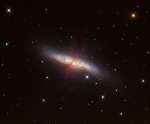 Bright Supernova in M82
24.01.2014
Astronomers really don't find supernovae by looking for the arrows. But in this image taken January 23rd, an arrow does point to an exciting, new supernova, now cataloged as SN 2014J, in nearby bright galaxy M82.
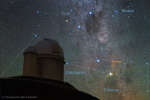 Closest Star has Potentially Habitable Planet
25.08.2016
The star closest to the Sun has a planet similar to the Earth. As announced yesterday, recent observations confirmed that this planet not only exists but inhabits a zone where its surface temperature could allow liquid water, a key ingredient for life on Earth.
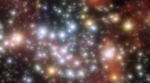 Journey to the Center of the Galaxy
29.07.2018
What wonders lie at the center of our Galaxy? In Jules Verne's science fiction classic A Journey to the Center of the Earth, Professor Liedenbrock and his fellow explorers encounter many strange and exciting wonders.
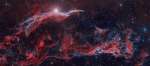 Along the Western Veil
4.04.2014
Delicate in appearance, these filaments of shocked, glowing gas, draped in planet Earth's sky toward the constellation of Cygnus, make up the western part of the Veil Nebula. The Veil Nebula itself is a large supernova remnant, an expanding cloud born of the death explosion of a massive star.
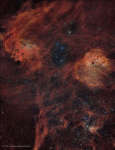 Nebulae in Aurigae
1.12.2015
Rich in star clusters and nebulae, the ancient constellation of the Charioteer (Auriga) rides high in northern winter night skies. Composed from narrow and broadband filter data and spanning nearly 8 Full Moons (4 degrees) on the sky, this deep telescopic view shows off some of Auriga's celestial bounty.
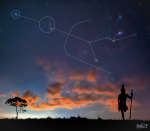 A Historic Brazilian Constellation
12.01.2021
The night sky is filled with stories. Cultures throughout history have projected some of their most enduring legends onto the stars above. Generations of people see these stellar constellations, hear the associated stories, and pass them down.
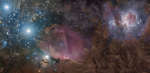 Orion in Gas, Dust, and Stars
29.09.2009
The constellation of Orion holds much more than three stars in a row. A deep exposure shows everything from dark nebula to star clusters, all imbedded in an extended patch of gaseous wisps in the greater Orion Molecular Cloud Complex.
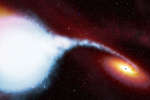 Black Hole Candidate Cygnus X 1
11.08.2008
Is that a black hole? Quite possibly. The Cygnus X-1 binary star system contains one of the best candidates for a black hole. The system was discovered because it is one of the brightest...
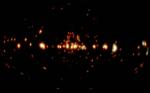 A Mystery in Gamma Rays
11.08.2001
Gamma rays are the most energetic form of light, packing a million or more times the energy of visible light photons. If you could see gamma rays, the familiar skyscape of steady stars would be replaced by some of the most bizarre objects known to modern astrophysics -- and some which are unknown.
|
January February March April May June July August September October |
|||||||||||||||||||||||||||||||||||||||||||||||||