
|
You entered: Earth's moon
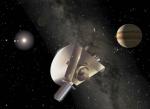 New Horizons at Jupiter
4.12.2003
Headed for the first close-up exploration of the Pluto-Charon system and the icy denizens of the Kuiper belt, NASA's New Horizons spacecraft is pictured here in an artist's vision of the robot probe outward bound.
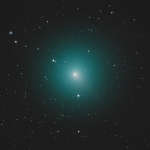 Comet 46P Wirtanen
15.11.2018
Periodic Comet 46P/Wirtanen is now the brightest comet in the night sky, but too faint to be seen by eye. From dark sky sites it could just become naked-eye visible though, as it's 5.4 year long looping orbit takes it closest to Earth and the Sun in mid December.
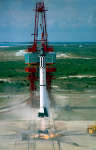 Mercury Redstone 3 Launch
7.05.2021
Sixty years ago, near the dawn of the space age, NASA controllers "lit the candle" and sent Mercury astronaut Alan Shepard arcing into space atop a Redstone rocket. His cramped space capsule was dubbed Freedom 7.
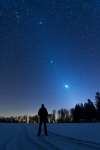 A Zodiacal Skyscape
23.02.2012
Venus and Jupiter are this month's two brightest planets. Shortly after sunset on February 20, they dominate the sky above the western horizon and this snowy landscape. In clear and transparent skies over Cherry Springs State Park, Pennsylvania, USA, they are also seen immersed in Zodiacal light.
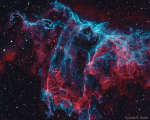 NGC 6995: The Bat Nebula
25.11.2019
Do you see the bat? It haunts this cosmic close-up of the eastern Veil Nebula. The Veil Nebula itself is a large supernova remnant, the expanding debris cloud from the death explosion of a massive star.
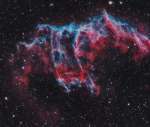 A Spectre in the Eastern Veil
30.10.2013
Frightening forms and scary faces are a mark of the Halloween season. They also haunt this cosmic close-up of the eastern Veil Nebula. The Veil Nebula itself is a large supernova remnant, the expanding debris cloud from the death explosion of a massive star.
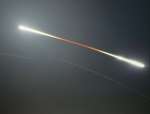 Moon Slide Slim
20.02.2008
No special filters - or even a telescope - are required to enjoy a leisurely lunar eclipse. In fact, watched from all over the night side of planet Earth, these regular celestial performances have entertained many casual skygazers. Still, this eye-catching picture of a lunar eclipse may look unfamiliar.
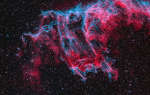 A Spectre in the Eastern Veil
29.10.2014
Frightening forms and scary faces are a mark of the Halloween season. They also haunt this cosmic close-up of the eastern Veil Nebula. The Veil Nebula itself is a large supernova remnant, the expanding debris cloud from the death explosion of a massive star.
 NGC 6995: The Bat Nebula
27.10.2021
Do you see the bat? It haunts this cosmic close-up of the eastern Veil Nebula. The Veil Nebula itself is a large supernova remnant, the expanding debris cloud from the death explosion of a massive star.
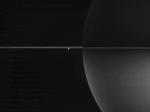 Thin Rings Around Polarized Saturn
19.12.2005
How thin are the rings of Saturn? Brightness measurements from different angles have shown Saturn's rings to be about one kilometer thick, making them many times thinner, in relative proportion, than a razor blade. This thinness sometimes appears in dramatic fashion during an image taken nearly along the ring plane.
|
January February March April May June July August September |
|||||||||||||||||||||||||||||||||||||||||||||||||