
|
You entered: Sun
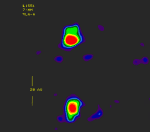 Twin Proto Planetary Disks
25.09.1998
Sun-like stars are forming - and probably planets too - hidden inside Lynds 1551, an interstellar cloud of molecular gas and dust in the constellation Taurus. Using new receivers, coordinated radio telescopes at the Very Large Array near Socorro, New Mexico, USA, can now sharply image the dusty proto-planetary disks surrounding these young stars at radio wavelengths.
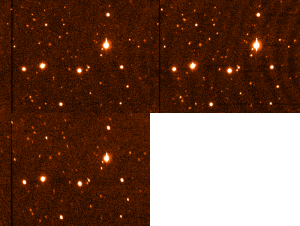 Orcus of the Outer Solar System
25.03.2009
A newly discovered object in the outer Solar System moves like an anti-Pluto. 90482 Orcus was first discovered in 2004 and is slightly smaller than Pluto, although still one of the largest Kuiper belt objects known. Orcus may one day have the same IAU designation as Pluto: a dwarf planet.
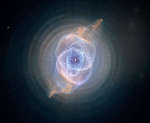 The Cat's Eye Nebula from Hubble
8.11.2014
To some, it may look like a cat's eye. The alluring Cat's Eye nebula, however, lies three thousand light-years from Earth across interstellar space. A classic planetary nebula, the Cat's Eye (NGC 6543) represents a final, brief yet glorious phase in the life of a sun-like star.
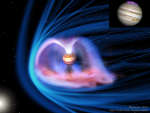 Auroras and the Magnetosphere of Jupiter
6.04.2016
Jupiter has auroras. Like near the Earth, the magnetic field of our Solar System's largest planet compresses when impacted by a gust of charged particles from the Sun. This magnetic compression funnels charged particles towards Jupiter's poles and down into the atmosphere.
 APOD: 2025 April 29 Б Saturns Rings Appear to Disappear
29.04.2025
Where are Saturn's ears? Galileo is credited, in 1610, as the first person to see Saturn's rings. Testing out Lipperhey's recently co-invented telescope, Galileo did not know what they were and so called them "ears". The mystery deepened in 1612, when Saturn's ears mysteriously disappeared.
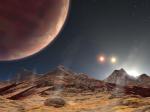 HD 188753: Triple Sunset
5.08.2005
Although it looks like fiction, this artist's vision of sunset on an alien world is based on fact -- the recent discovery of a hot, jupiter-sized planet orbiting in triple star system HD 188753.
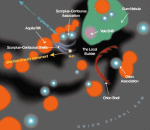 The Local Bubble and the Galactic Neighborhood
12.04.2000
What surrounds the Sun in this neck of the Milky Way Galaxy? Our current best guess is depicted in the above map of the surrounding 1500 light years constructed from various observations and deductions.
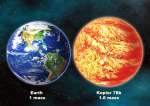 Kepler 78b: Earth Sized Planet Discovered
5.11.2013
Even though Kepler-78b is only slightly larger than the Earth, it should not exist. Its size is extraordinary only in the sense that it is the most similar in size to the Earth of any exoplanet yet directly discovered.
 ISS Double Transit
12.09.2015
Not once, but twice the International Space Station transits the Sun on consecutive orbits of planet Earth in this video frame composite. The scene was captured on August 22 from a single well-chosen location in Schmalenbeck, Germany where the ISS created intersecting shadow paths only around 7 kilometers wide.
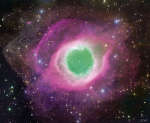 The Helix Nebula from CFHT
3.01.2018
Will our Sun look like this one day? The Helix Nebula is one of brightest and closest examples of a planetary nebula, a gas cloud created at the end of the life of a Sun-like star.
|
January February March April May June July August September October |
|||||||||||||||||||||||||||||||||||||||||||||||||