
|
You entered: cluster
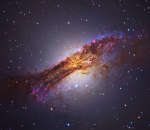 Centaurus A
19.11.2015
What's the closest active galaxy to planet Earth? That would be Centaurus A, only 11 million light-years distant. Spanning over 60,000 light-years, the peculiar elliptical galaxy is also known as NGC 5128.
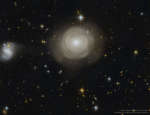 Shells of Stars in Elliptical Galaxy PGC 42871
29.10.2018
How do galaxies grow? To help find out, the Hubble Space Telescope was deployed to image the unusual elliptical galaxy PGC 42871. How this galaxy came to be surrounded by numerous shells of stars may give clues about how it evolved.
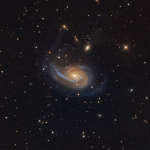 Arp 78: Peculiar Galaxy in Aries
18.09.2020
(xxxedit and linkxxx) Peculiar spiral galaxy Arp 78 is found within the boundaries of the head strong constellation Aries, some 100 million light-years beyond the stars and nebulae of our Milky Way galaxy. Also...
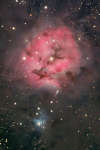 IC 5146: The Cocoon Nebula
27.08.2022
Inside the Cocoon Nebula is a newly developing cluster of stars. Cataloged as IC 5146, the beautiful nebula is nearly 15 light-years wide. Climbing high in northern summer night skies, it's located some 4,000 light years away toward the constellation Cygnus the Swan.
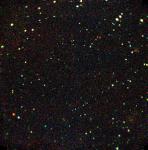 Chandra Deep Field
28.03.2001
Officially the Chandra Deep Field - South, this picture represents the deepest ever x-ray image of the Universe. One million seconds of accumulated exposure time with the orbiting Chandra X-ray Observatory went in to its making.
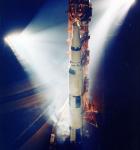 Saturn The Giant
25.05.2001
Forty years ago today (May 25, 1961) U.S. president John Kennedy announced the goal of landing Americans on the Moon by the end of the decade. Kennedy's ambitious speech triggered a nearly unprecedented peacetime technological mobilization and one result was the Saturn V moon rocket.
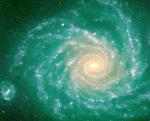 Spiral Galaxy NGC 1232
22.05.2001
Galaxies are fascinating not only for what is visible, but for what is invisible. Grand spiral galaxy NGC 1232, captured in detail by one of the new Very Large Telescopes, is a good example.
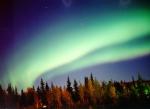 The Secret of the Black Aurora
1.01.2002
What causes black aurora? These gaps in normal bright aurora are frequently recorded but rarely questioned. Recent research using data from four Cluster spacecraft orbiting the Earth has now likely found the secret: black auroras are actually anti-auroras.
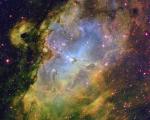 Inside the Eagle Nebula
11.06.2002
From afar, the whole thing looks like an Eagle. A closer look of the Eagle Nebula, however, shows the bright region is actually a window into the center of a larger dark shell of dust. Through this window, a brightly-lit workshop appears where a whole open cluster of stars is being formed.
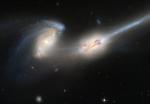 NGC 4676: When Mice Collide
12.06.2004
These two mighty galaxies are pulling each other apart. Known as "The Mice" because they have such long tails, each spiral galaxy has likely already passed through the other. They will probably collide again and again until they coalesce.
|
January February March April May June July August September October |
|||||||||||||||||||||||||||||||||||||||||||||||||