
|
You entered: dark
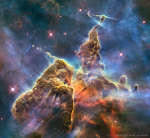 Mountains of Dust in the Carina Nebula
1.07.2017
It's stars versus dust in the Carina Nebula and the stars are winning. More precisely, the energetic light and winds from massive newly formed stars are evaporating and dispersing the dusty stellar nurseries in which they formed.
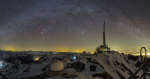 Pic du Midi Panorama
6.03.2020
A surreal night skyscape, this panorama stitched from 12 photos looks to the west at an evening winter sky over Pic du Midi Observatory, Pyrenees Mountains, Planet Earth. Telescope domes and a tall communications tower inhabit the rugged foreground.
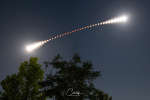 A Digital Lunar Eclipse
18.05.2022
Recorded on May 15/16 this sequence of exposures follows the Full Moon during a total lunar eclipse as it arcs above treetops in the clearing skies of central Florida. A frame taken every 5 minutes by a digital camera shows the progression of the eclipse over three hours.
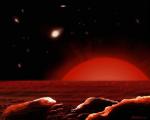 Stars Without Galaxies
18.01.2002
Galaxies are made up of stars, but are all stars found within galaxies? Using the Hubble Space Telescope, researchers exploring the Virgo Cluster of galaxies have found about 600 red giant stars adrift in intergalactic space. Above is an artist's vision of the sky from a hypothetical planet of such a lonely sun.
 Sagittarius and the Central Milky Way
5.06.1996
What does the center of our Milky Way Galaxy look like? No one knows! It is not possible to see the Galactic center in light our eyes are sensitive to because the thick dust in the plane of our Galaxy obscures it.
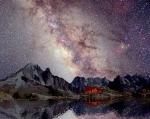 The Milky Way Over Mount Blanc
23.09.2002
Have you ever seen the band of our Milky Way Galaxy? Chances are you have never seen it like this -- nor could you. In a clear sky from a dark location at the right time, a faint band of light is visible across the sky. This band is the disk of our spiral galaxy.
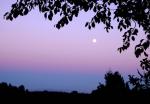 Shadow Rise
22.08.2003
As the Sun sets, the Earth's shadow rises up from the east. The subtle beauty of this daily apparition is often overlooked in favor of the brighter, more colorful western horizon. But while...
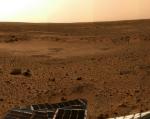 Sol 5 Postcard from Mars
8.01.2004
A martian Sol - the average martian solar day - is about 39 minutes longer than Earth's familiar 24 hour day. Operating on martian time, the Spirit rover recently sent back this color postcard image, recorded on Sol 5 of its stay on the martian surface.
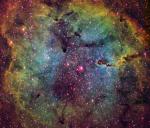 Emission Nebula IC 1396
5.08.2004
Sprawling across hundreds of light-years, emission nebula IC 1396 mixes glowing cosmic gas and dark dust clouds. Stars are forming in this area, only about 3,000 light-years from Earth. This particularly colorful view of the region is a composite of digital images recorded through narrow band filters.
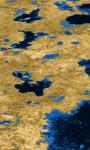 Liquid Lakes on Saturns Titan
6.02.2007
Why would some regions on Titan reflect very little radar? The leading explanation is that these regions are lakes, possibly composed of liquid methane. The above image is a false-color synthetic radar map of a northern region of Titan taken during a flyby of the cloudy moon by the robotic Cassini spacecraft last July.
|
January February March April May June July August September |
|||||||||||||||||||||||||||||||||||||||||||||||||