
|
You entered: Milky Way
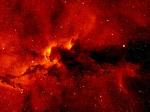 IC 1396 Close Up
30.09.2005
Clouds of glowing hydrogen gas mingle ominously with dark dust lanes in this close-up of IC 1396, an active star forming region some 2,000 light years away in the constellation Cepheus. In this and other similar emission nebulae, energetic ultraviolet light from a hot young star strips electrons from the surrounding hydrogen atoms.
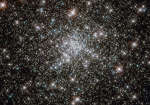 At the Core of NGC 6752
10.02.2012
This sharp Hubble Space Telescope view looks deep into NGC 6752. Some 13,000 light-years away toward the southern constellation Pavo, the globular star cluster roams the halo of our Milky Way galaxy. Over...
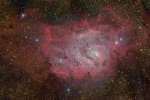 M8: The Lagoon Nebula
17.08.2013
This beautiful cosmic cloud is a popular stop on telescopic tours of the constellation Sagittarius. Eighteenth century cosmic tourist Charles Messier cataloged the bright nebula as M8. Modern day astronomers recognize the Lagoon Nebula as an active stellar nursery about 5,000 light-years distant, in the direction of the center of our Milky Way Galaxy.
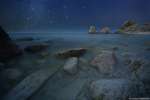 Andromeda on the Rocks
27.09.2013
How far can you see? The Andromeda Galaxy 2.5 million light years away is the most distant object easily seen by the unaided eye. Other apparent denizens of the night sky, stars, clusters...
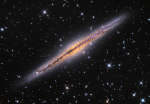 NGC 891 Edge On
11.10.2013
This sharp cosmic portrait features NGC 891. The spiral galaxy spans about 100 thousand light-years and is seen almost exactly edge-on from our perspective. In fact, about 30 million light-years distant in the constellation Andromeda, NGC 891 looks a lot like our Milky Way.
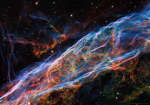 Veil Nebula: Wisps of an Exploded Star
5.04.2021
Wisps like this are all that remain visible of a Milky Way star. About 7,000 years ago that star exploded in a supernova leaving the Veil Nebula. At the time, the expanding cloud was likely as bright as a crescent Moon, remaining visible for weeks to people living at the dawn of recorded history.
 APOD: 2024 September 24 Б NGC 6727: The Rampaging Baboon Nebula
24.09.2024
This dusty region is forming stars. Part of a sprawling molecular cloud complex that resembles, to some, a rampaging baboon, the region is a relatively close by 500 light-years away toward the constellation Corona Australis. That's about one third the distance of the more famous stellar nursery known as the Orion Nebula.
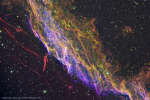 NGC 6992: Filaments of the Veil Nebula
1.12.2009
Wisps like this are all that remain visible of a Milky Way star. About 7,500 years ago that star exploded in a supernova leaving the Veil Nebula, also known as the Cygnus Loop.
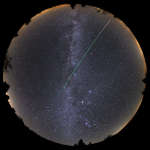 Night of the Long Leonid
22.11.2012
A cosmic grain of sand left the long and colorful trail across this all-sky view. Its grazing impact with planet Earth's atmosphere began at 71 kilometers per second. With the Milky Way stretching...
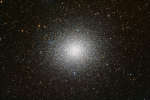 Omega Centauri: The Brightest Globular Cluster
1.05.2013
This huge ball of stars predates our Sun. Long before humankind evolved, before dinosaurs roamed, and even before our Earth existed, ancient globs of stars condensed and orbited a young Milky Way Galaxy. Of the 200 or so globular clusters that survive today, Omega Centauri is the largest, containing over ten million stars.
|
January February March April May June July August September October |
|||||||||||||||||||||||||||||||||||||||||||||||||