
|
You entered: image
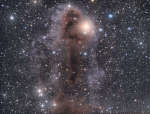 Lynds Dark Nebula 1251
31.05.2019
Stars are forming in Lynds Dark Nebula (LDN) 1251. About 1,000 light-years away and drifting above the plane of our Milky Way galaxy, the dusty molecular cloud is part of a complex of dark nebulae mapped toward the Cepheus flare region.
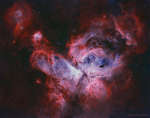 The Great Nebula in Carina
25.04.2022
In one of the brightest parts of Milky Way lies a nebula where some of the oddest things occur. NGC 3372, known as the Great Nebula in Carina, is home to massive stars and changing nebulas. The Keyhole Nebula (NGC 3324), the bright structure just below the image center, houses several of these massive stars.
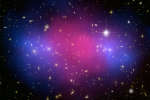 MACSJ0025: Two Giant Galaxy Clusters
Collide
MACSJ0025: Two Giant Galaxy Clusters
Collide
17.09.2008
What happens when two of the largest objects in the universe collide? No one was quite sure, but the answer is giving clues to the nature of mysterious dark matter. In the case of MACSJ0025.
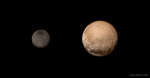 New Horizons Passes Pluto and Charon
14.07.2015
Will the New Horizons spacecraft survive its closest approach to Pluto and return useful images and data? Humanity will know in a few hours. Regardless of how well it functions, New Horizon's rapid...
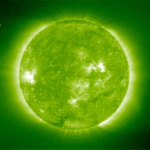 Sun and Winter Solstice 1996
21.12.1996
Today is the Winter Solstice for 1996. After steadily sinking in Northern Hemisphere skies, the Sun is now at its lowest declination - marking the first day of Northern Winter (but Southern Summer!). The Earth...
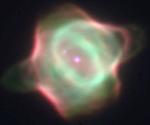 Hen 1357: New Born Nebula
3.04.1998
This Hubble Space Telescope picture shows Hen-1357, the youngest known planetary nebula. Graceful, gentle curves and symmetry suggest its popular name - The Stingray Nebula. Observations in the 1970s detected no nebular material, but this image from March 1996 clearly shows the Stingray's emerging bubbles and rings of shocked and ionized gas.
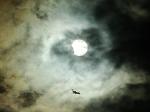 Clouds, Plane, Sun, Eclipse
11.04.2005
How can part of the Sun just disappear? When that part is really hiding behind the Moon. Last Friday, the first partial solar eclipse of 2005 and the last total eclipse of the Sun until March 2006 was visible. During a solar eclipse, the Sun, Moon and Earth are aligned.
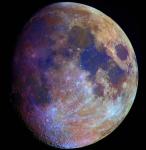 The Color of the Moon
16.02.2006
Earth's Moon is normally seen in subtle shades of grey or yellow. But small color differences have been greatly exaggerated to make this dramatic mosaic image of the Moon's gibbous phase. The familiar Sea of Tranquility (Mare Tranquillitatis) is the blue area right of center.
 The Cat's Eye Nebula
31.10.1999
Three thousand light-years away, a dying star throws off shells of glowing gas. This image from the Hubble Space Telescope reveals The Cat's Eye Nebula to be one of the most complex planetary nebulae known.
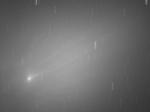 The Inner Coma of Comet Holmes
13.11.2007
What's happening to Comet Holmes? The rare comet remains visible to the unaided eyes of northern observers as an unusual small puff ball in the constellation of Perseus. A high resolution set of images of the comet's inner coma, taken last week and shown above, reveals significant detail.
|
January February March April May June July August September |
|||||||||||||||||||||||||||||||||||||||||||||||||