
|
You entered: star cluster
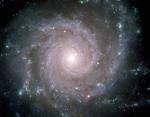 M74: The Perfect Spiral
4.10.2001
If not perfect, then this spiral galaxy is at least one of the most photogenic. An island universe of about 100 billion stars, 30 million light-years away toward the constellation Pisces, NGC 628 or M74 presents a gorgeous face-on view to earthbound astronomers.
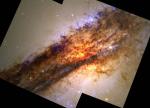 The Center of Centaurus A
1.10.2000
A fantastic jumble of young blue star clusters, gigantic glowing gas clouds, and imposing dark dust lanes surrounds the central region of the active galaxy Centaurus A. This mosaic of Hubble Space Telescope images taken in blue, green, and red light has been processed to present a natural color picture of this cosmic maelstrom.
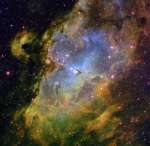 Inside the Eagle Nebula
16.02.2014
From afar, the whole thing looks like an Eagle. A closer look at the Eagle Nebula, however, shows the bright region is actually a window into the center of a larger dark shell of dust. Through this window, a brightly-lit workshop appears where a whole open cluster of stars is being formed.
 M16: Inside the Eagle Nebula
28.12.2020
From afar, the whole thing looks like an Eagle. A closer look at the Eagle Nebula, however, shows the bright region is actually a window into the center of a larger dark shell of dust. Through this window, a brightly-lit workshop appears where a whole open cluster of stars is being formed.
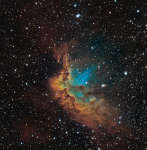 The Wizard Nebula
29.08.2014
Open star cluster NGC 7380 is still embedded in its natal cloud of interstellar gas and dust popularly known as the Wizard Nebula. Seen with foreground and background stars along the plane of our Milky Way galaxy it lies some 8,000 light-years distant, toward the constellation Cepheus.
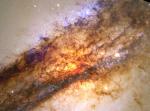 The Center of Centaurus A
17.07.2005
A fantastic jumble of young blue star clusters, gigantic glowing gas clouds, and imposing dark dust lanes surrounds the central region of the active galaxy Centaurus A. This mosaic of Hubble Space Telescope images taken in blue, green, and red light has been processed to present a natural color picture of this cosmic maelstrom.
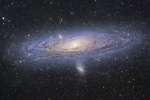 Andromeda Island Universe
24.01.2008
The most distant object easily visible to the unaided eye is M31, the great Andromeda Galaxy some two and a half million light-years away. But without a telescope, even this immense spiral galaxy - spanning over 200,000 light years - appears as a faint, nebulous cloud in the constellation Andromeda.
 APOD: 2025 June 17 Б Rosette Nebula Deep Field
17.06.2025
Can you find the Rosette Nebula? The red flowery-looking nebula just above the image center may seem a good choice, but that's not it. The famous Rosette Nebula is really located on the lower right, here colored blue and white, and connected to the other nebulas by gold-colored filaments.
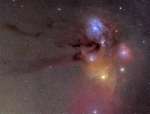 The Dark River to Antares
8.07.2009
Connecting the Pipe Nebula to the colorful regon near bright star Antares is a dark cloud dubbed the Dark River, flowing from the picture's left edge. Murky looking, the Dark River's appearance is caused by dust obscuring background starlight, although the dark nebula contains mostly hydrogen and molecular gas.
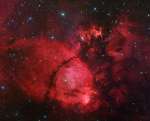 The Color of IC 1795
13.10.2011
This sharp cosmic portrait features glowing gas and obscuring dust clouds in IC 1795, a star forming region in the northern constellation Cassiopeia. Also cataloged as NGC 896, the nebula's remarkable details, shown...
|
January February March April May June July August September October |
|||||||||||||||||||||||||||||||||||||||||||||||||