
|
You entered: Mercury
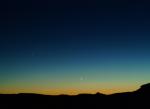 Planets in the West
24.06.2005
This weekend three planets will grace the western sky, forming a lovely trio easily visible shortly after sunset. Saturday evening in particular will find Saturn, Venus, and Mercury all within a 2 degree circle (about the size of your thumb held at arm's length) above the western horizon.
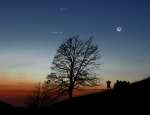 Moon and Planets in the Morning
22.10.2009
Last Friday, a gathering of three bright planets and the Moon graced the morning sky. With Mercury, Venus, Saturn, and a narrow lunar crescent close to the eastern horizon in the dawn twilight, this picture of the beautiful conjunction was recorded near Noerdlingen, Germany.
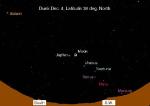 A Sky Full Of Planets
4.12.1997
Look up tonight. Just after sunset, the crescent moon and all five "naked-eye" planets (Mercury, Venus, Mars, Jupiter, and Saturn) will be visible (depending on your latitude), lying near our solar system's ecliptic plane.
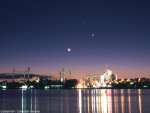 Planets over Perth
12.09.2008
A bright trio of terrestrial planets were joined by a young Moon on September 1st, in planet Earth's early evening skies. In this view of the celestial gathering from Perth, Western Australia, the Moon's sunlit crescent is nearly horizontal at Perth's southern latitude of about 32 degrees.
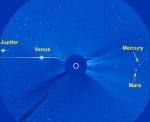 Children of the Sun
16.11.2006
For a moment, planets Jupiter, Venus, Mars, and Mercury all posed near their parent star in this Sun-centered view, recorded on November 11. The picture, from a coronograph onboard the space-based SOlar Heliospheric Observatory, spans 15 degrees with the Sun's size and position indicated by the white circle.
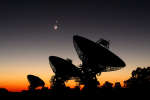 Planets Align Over Australian Radio Telescope Array
10.03.2008
Last week, Mercury, Venus, and the Moon all appeared close together in Earth's sky. This picturesque conjunction was caught on camera behind elements of the Australia Telescope Compact Array (ATCA) near the town of Narrabri in rural New South Wales.
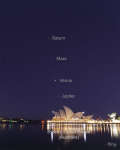 APOD: 2026 February 24 Б Planet Parade over Sydney Opera House
24.02.2026
Look up this week and see a whole bunch of planets. Just after sunset, looking west (mostly), planets Mercury, Venus, Saturn, and Jupiter will all be visible to the unaided eye simultaneously. If you have a telescope, planets Uranus and Neptune can also be seen.
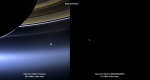 Two Views of Earth
23.07.2013
In a cross-Solar System interplanetary first, our Earth was photographed during the same day from both Mercury and Saturn. Pictured on the left, Earth is the pale blue dot just below the rings of Saturn, as captured by the robotic Cassini spacecraft now the gas giant.
 A Planet Transits the Sun
8.06.2004
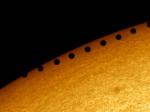
Today an astronomical event will occur that no living person has ever seen: Venus will cross directly in front of the Sun. A Venus crossing, called a transit, last occurred in 1882 and was front-page news around the world.
 SOHO: Comet McNaught Movie
20.01.2007
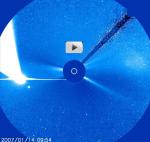
This frame from a spectacular time lapse movie shows Comet McNaught - the Great Comet of 2007 - sweeping through the inner solar system. The movie frames were recorded from January 12 through Jan 16 by a coronograph onboard the sun-staring SOHO spacecraft.
|
January February March April May June July August September October |
|||||||||||||||||||||||||||||||||||||||||||||||||