
|
You entered: NASA
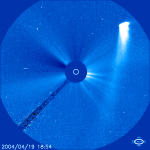 Comet Bradfield Passes the Sun
19.04.2004
Right now, Comet Bradfield is passing the Sun. The above image, the latest taken in the direction of the Sun by the SOHO LASCO instrument, shows the comet and its dust tail as the elongated white streak. The Sun would normally be seen in the very center but has been blocked from view.
 M87 s Energetic Jet
11.12.2004
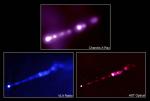
An energetic jet from the core of giant elliptical galaxy M87 stretches outward for 5,000 light-years. This monstrous jet appears in the panels above to be a knotted and irregular structure, detected across the spectrum, from x-ray to optical to radio wavelengths.
 Sibling Supernova Remnants
2.07.2026
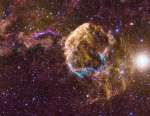
What happens when one of the stars in a binary goes supernova? This image combines visible (yellow), ultraviolet (purple) and infrared light (cyan, red and orange) to show two supernova remnants and their surrounding environment, about 6,000 light-years away. The younger one is the well-known Jellyfish Nebula in the center (mostly in yellow).
 Barsoom
24.04.1999
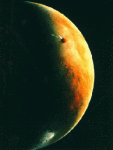
"Yes, I have been to Barsoom again ..." begins John Carter in Edgar Rice Burroughs' 1913 science fiction classic "The Gods of Mars". In Burroughs' novels describing Carter's adventures on Mars, "Barsoom" is the local inhabitants' name for the Red Planet. Long after Burroughs' stories were published, Mars continues to inspire Earthdwellers' interests and imagination.
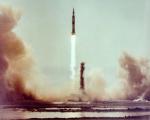 Happy Birthday Jules Verne
15.02.2003
One hundred seventy-five years ago (on February 8th), Jules Verne was born in Nantes, France. Inspired by a lifelong fascination with machines, Verne wrote visionary works about "Extraordinary Voyages" including such terrestrial travels as Around the World in 80 Days, Journey to the Centre of the Earth, and Twenty Thousand Leagues Under the Sea.
 Farewell Jupiter
8.08.2001
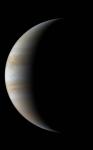
Next stop: Saturn. The Cassini spacecraft, launched from Earth four years ago, has now swung past Jupiter and should arrive at Saturn in the year 2004. Pictured to the left is a parting shot from Cassini in January that would not have been possible from Earth: Jupiter showing a crescent phase.
 A Portrait of Saturn from Titan
16.07.1996
The above artistic portrait of Saturn depicts how it might look from Titan, Saturn's largest moon. In the foreground sits ESA's Huygens probe, which will be released by NASA's Cassini spacecraft. The Cassini mission to Saturn in currently planned for launch in late 1997.
 X Ray Superbubbles in Galaxy NGC 3079
5.03.2019
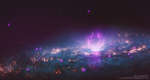
What created these huge galactic superbubbles? Two of these unusual bubbles, each spanning thousands of light-years, were recently discovered near the center of spiral galaxy NGC 3079. The superbubbles, shown in purple on the image right, are so hot they emit X-rays detected by NASA's Earth-orbiting Chandra X-Ray Observatory.
 The Earth Also Rises
25.03.2000
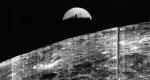
The Lunar Orbiter 1 spacecraft was launched in 1966 to map the lunar surface in preparation for the Apollo moon landings. NASA's plucky robotic explorer performed its job well and pioneered this classic view of the Earth poised above the lunar horizon.
 Jupiter from Voyager
25.06.1995
Imagine a hurricane that lasted for 300 years! This picture of the planet Jupiter was taken by the Voyager 1 spacecraft as it passed the planet in 1979. Jupiter, a gas giant planet with no solid surface, is the largest planet in the solar system and is made mostly of the hydrogen and helium.
|
January February March April May June July August September October |
|||||||||||||||||||||||||||||||||||||||||||||||||