
|
You entered: Orion
 Trapezium: At the Heart of Orion
5.01.2024
Near the center of this sharp cosmic portrait, at the heart of the Orion Nebula, are four hot, massive stars known as the Trapezium. Gathered within a region about 1.5 light-years in radius, they dominate the core of the dense Orion Nebula Star Cluster.
 The Heart Of Orion
23.05.1997
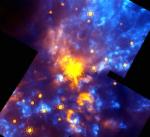
Newborn stars lie at the heart of the Orion Nebula, hidden from view by the dust and gas of the giant Orion Molecular Cloud number 1 (OMC-1). Sensitive to invisible infrared wavelengths, Hubble...
 Classic Orion Nebulae
26.08.2009
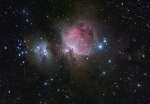
The Great Nebula in Orion, also known as M42, is one of the most famous nebulae in the sky. The star forming region's glowing gas clouds and hot young stars are near...
 Orion and the Ocean of Storms
7.12.2023
On December 5, 2022, a camera on board the uncrewed Orion spacecraft captured this view as Orion approached its return powered flyby of the Moon. Beyond one of Orion's extended solar arrays lies dark, smooth, terrain along the western edge of the Oceanus Procellarum.
 Geostationary Highway through Orion
16.01.2017
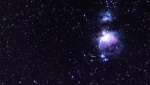
Put a satellite in a circular orbit about 42,000 kilometers from the center of the Earth and it will orbit once in 24 hours. Because that matches Earth's rotation period, it is known as a geosynchronous orbit.
 Orion Rising over Brazil
30.09.2019
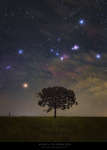
Have you seen Orion lately? The next few months will be the best for seeing this familiar constellation as it rises continually earlier in the night. However, Orion's stars and nebulas won't look quite as colorful to the eye as they do in this fantastic camera image.
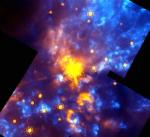 The Heart Of Orion
6.05.2000
Newborn stars lie at at the heart of the the Orion Nebula, hidden from view by the dust and gas of the giant Orion Molecular Cloud number 1 (OMC-1). Sensitive to invisible infrared...
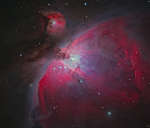 At the Heart of Orion
12.03.2017
Near the center of this sharp cosmic portrait, at the heart of the Orion Nebula, are four hot, massive stars known as the Trapezium. Tightly gathered within a region about 1.5 light-years in radius, they dominate the core of the dense Orion Nebula Star Cluster.
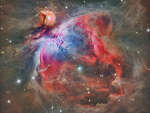 M42: Inside the Orion Nebula
20.03.2013
The Great Nebula in Orion, an immense, nearby starbirth region, is probably the most famous of all astronomical nebulas. Here, glowing gas surrounds hot young stars at the edge of an immense interstellar molecular cloud only 1500 light-years away.
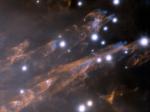 Bullet Pillars in Orion
26.03.2007
Why are bullets of gas shooting out of the Orion Nebula? Nobody is yet sure. First discovered in 1983, each bullet is actually about the size of our Solar System, and moving at about 400 km/sec from a central source dubbed IRc2.
|
January February March April May June July August September |
|||||||||||||||||||||||||||||||||||||||||||||||||