
|
You entered: cassini spacecraft
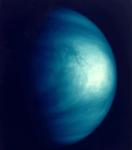 Venus: Just Passing By
12.06.1999
Venus, the second closest planet to the Sun, is a popular way-point for spacecraft headed for the gas giant planets in the outer reaches of the solar system. Why visit Venus first? Using...
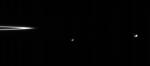 Epimetheus and Janus: Interchangeable Moons of Saturn
1.11.2005
These two moons change places. Epimetheus and Janus, two small moons of Saturn, actually switch positions as they orbit their home planet. The orbital radii of the moons are strangely separated by less than the radii of the moons themselves: about 50 kilometers. One moon orbits Saturn well ahead of the other, at first.
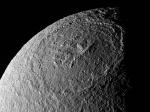 The Great Basin on Tethys
7.02.2006
Some moons wouldn't survive the collision. Tethys, one of Saturn's larger moons at about 1000 kilometers in diameter, survived the collision, but sports today the expansive impact crater Odysseus. Sometimes called...
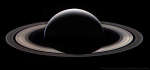 Cassinis Last Ring Portrait at Saturn
25.09.2017
How should Cassini say farewell to Saturn? Three days before plunging into Saturn's sunny side, the robotic Cassini spacecraft swooped far behind Saturn's night side with cameras blazing. Thirty-six of these images...
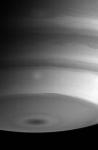 Southern Saturn from Cassini
18.10.2004
What happens to Saturn's pervasive clouds at its South Pole? Visible in the above image of Saturn are bright bands, dark belts and a dark spot right over the South Pole. The above...
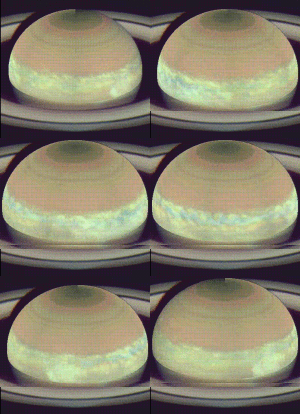 Saturn Rotates
3.10.2000
The dramatic rotation of the cloud-tops of Saturn every ten-hours is particularly evident from orbit around the gas giant planet. With a good enough telescope, however, such rotation is visible even from Earth, as shown by this time-lapse image sequence from the Hubble Space Telescope taken in November 1990.
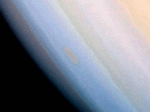 Saturn's Cloud Tops
16.03.1996
This close-up of the tops of Saturn's clouds was taken by the Voyager 1 robot spacecraft as it passed the giant planet in November 1980. Saturn's clouds are mostly composed of hydrogen and helium gas, but the small addition of other elements gives the clouds their colors.
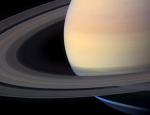 Big Beautiful Saturn
24.12.2004
As a present to APOD readers, digital imager Mattias Malmer offers a very high resolution view of big beautiful Saturn. A labor of love, his full mosaic, composite image is contained in a large 5 megabyte jpeg file (preview here, download here) and spans the gorgeous gas giant from ring tip to ring tip.
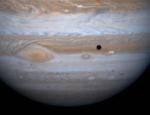 Jupiter, Io, and Shadow
6.12.2002
Pictured above is the innermost of Jupiter's Galilean satellites, Io, superposed in front of the gas giant planet. To the left of Io is a dark spot that is Io's own shadow. A solar eclipse would be seen from within the shadow spot on Jupiter.
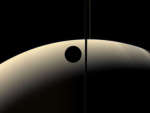 Crescent Rhea Occults Crescent Saturn
3.01.2015
Soft hues, partially lit orbs, a thin trace of the ring, and slight shadows highlight this understated view of the majestic surroundings of the giant planet Saturn. Looking nearly back toward the Sun, the robot Cassini spacecraft now orbiting Saturn captured crescent phases of Saturn and its moon Rhea in color a few years ago.
|
January February March April May June July August September October |
|||||||||||||||||||||||||||||||||||||||||||||||||