
|
You entered: crater
 Bright Spots Resolved in Occator Crater on Ceres
16.09.2015
What created these bright spots on Ceres? The spots were first noted as the robotic Dawn spacecraft approached Ceres, the largest object in the asteroid belt, in February, with the expectation that the mystery would soon be solved in higher resolution images. However, even after Dawn arrived at Ceres in March, the riddle remained.
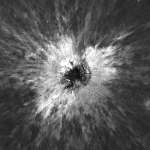 APOD: 2026 September 23 Б A New Lunar Crater: McGetchin
23.09.2026
A once-in-a-lifetime crater has appeared on the Moon! A comet or asteroid roughly the size of a humpback whale (approximately 10-20 meters, 30-60 feet) crashed into the Moon sometime between April and May of 2024.
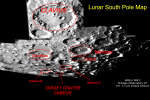 Target Crater Cabeus
8.10.2009
About 100 kilometers from the Moon's South Pole, 100 kilometer wide crater Cabeus is the target for two LCROSS mission spacecraft on course to impact the Moon tomorrow. The shadowed crater is strongly foreshortened in this mosaic, a representative view of the region for earthbound telescopes.
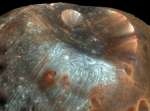 Stickney Crater
7.11.2009
Stickney Crater, the largest crater on the martian moon Phobos, is named for Chloe Angeline Stickney Hall, mathematician and wife of astronomer Asaph Hall. Asaph Hall discovered both the Red Planet's moons in 1877.
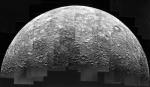 Mercury: A Cratered Inferno
19.08.2001
Mercury's surface looks similar to our Moon's. Each is heavily cratered and made of rock. Mercury's diameter is about 4800 km, while the Moon's is slightly less at about 3500 km (compared with about 12,700 km for the Earth). But Mercury is unique in many ways.
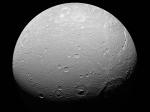 APOD: 2007 August 1- Unusual Cratering on Saturns Dione
1.08.2007
Why does one half of Dione have more craters than the other? Start with the fact that Saturn's moon Dione always has one side that faces Saturn, and always has one side that faces away. This is similar to Earth's Moon.
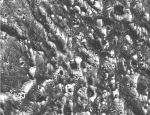 Ancient Cratered Plains on Ganymede
12.07.1996
The largest moon in the Solar System shows regions that are ancient and battered. The high density of craters demonstrate that patches of Ganymede are indeed billions of years old. This photo is one of a series released by NASA two days ago from the Galileo spacecraft orbiting Jupiter.
 Mercury: A Cratered Inferno
12.09.1996
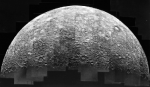
Mercury's surface looks similar to our Moon's. Each is heavily cratered and made of rock. Mercury's diameter is about 4800 km, while the Moon's is slightly less at about 3500 km (compared with about 12,700 km for the Earth). But Mercury is unique in many ways.
 Mercury: A Cratered Inferno
30.11.1997
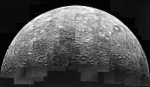
Mercury's surface looks similar to our Moon's. Each is heavily cratered and made of rock. Mercury's diameter is about 4800 km, while the Moon's is slightly less at about 3500 km (compared with about 12,700 km for the Earth). But Mercury is unique in many ways.
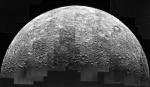 Mercury: A Cratered Inferno
2.01.1999
Mercury's surface looks similar to our Moon's. Each is heavily cratered and made of rock. Mercury's diameter is about 4800 km, while the Moon's is slightly less at about 3500 km (compared with about 12,700 km for the Earth). But Mercury is unique in many ways.
|
January February March April May June July August September October |
|||||||||||||||||||||||||||||||||||||||||||||||||