
|
You entered: globular cluster
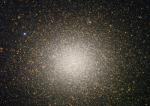 NGC 5139: Omega Centauri
19.04.2007
Centaurus is one of the most striking constellations in the southern sky. The Milky Way flows through this celestial expanse whose wonders also include the closest star system to the Sun, Alpha Centauri, and the largest globular star cluster in our galaxy, Omega Centauri (aka NGC 5139).
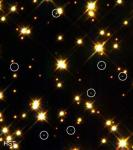 White Dwarf Stars Cool
1.11.1997
Diminutive by stellar standards, white dwarf stars are also intensely hot ... but they are cooling. No longer do their interior nuclear fires burn, so they will continue to cool until they fade away. This Hubble Space Telescope image covers a small region near the center of a globular cluster known as M4.
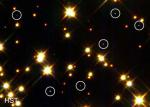 White Dwarf Stars Cool
10.09.2000
Diminutive by stellar standards, white dwarf stars are also intensely hot ... but they are cooling. No longer do their interior nuclear fires burn, so they will continue to cool until they fade away. This Hubble Space Telescope image covers a small region near the center of a globular cluster known as M4.
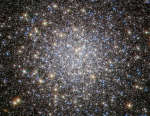 Hubble s Messier 5
3.11.2017
"Beautiful Nebula discovered between the Balance [Libra] & the Serpent [Serpens] ..." begins the description of the 5th entry in 18th century astronomer Charles Messier's famous catalog of nebulae and star clusters. Though it appeared...
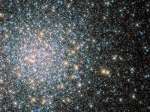 Hubble s Messier 5
25.04.2014
"Beautiful Nebula discovered between the Balance [Libra] & the Serpent [Serpens] ..." begins the description of the 5th entry in 18th century astronomer Charles Messier's famous catalog of nebulae and star clusters. Though it appeared...
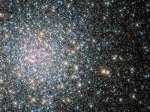 Hubble s Messier 5
19.06.2015
"Beautiful Nebula discovered between the Balance [Libra] & the Serpent [Serpens] ..." begins the description of the 5th entry in 18th century astronomer Charles Messier's famous catalog of nebulae and star clusters. Though it appeared...
 White Dwarfs Cool
10.09.1995
The circled stars in the above picture are from a class that is hard to see in the cosmos: white dwarfs. The entire photo covers a small region near the center of a globular cluster known as M4. Researchers using the Hubble Space Telescope discovered a large concentration of white dwarfs in M4.
 Messier 4
28.11.2024
Messier 4 can be found west of bright red-giant star Antares, alpha star of the constellation Scorpius. M4 itself is only just visible from dark sky locations, even though the globular cluster of 100,000 stars or so is a mere 5,500 light-years away.
 The Dark Doodad Nebula
7.12.2008
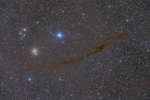
What is that strange dark ribbon on the sky? When observing the great globular cluster NGC 4372, observers frequently take note of a strange dark streak nearly three degrees in length running near it. Unnamed, the streak, actually a long molecular cloud, has become known as the Dark Doodad Nebula.
 The Gaia Stars of M15
27.03.2019
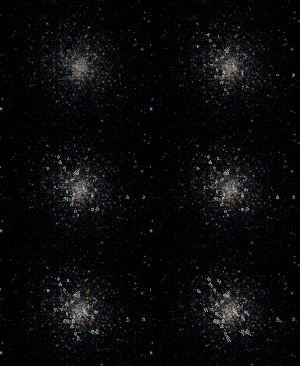
Messier 15 is a 13 billion year old relic of the early formative years of our galaxy, one of about 170 globular star clusters that still roam the halo of the Milky Way. About 200 light-years in diameter, it lies about 35,000 light years away toward the constellation Pegasus.
|
January February March April May June July August September |
|||||||||||||||||||||||||||||||||||||||||||||||||