
|
You entered: lunar orbiter
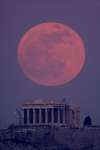 Parthenon Moon
20.03.2011
Did you see the Full Moon last night? Near the horizon, the lunar orb may have seemed to loom large, swollen in appearance by the famous Moon illusion. But the Full Moon really...
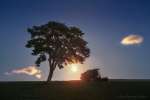 A Harvest Moon
13.09.2019
Famed in festival, story, and song the best known full moon is the Harvest Moon. For northern hemisphere dwellers that's a traditional name of the closest full moon to the September equinox. In most North America time zones this year's Harvest Moon will officially rise on Friday, September 13.
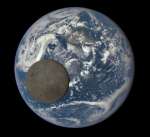 Full Earth, Full Moon
7.08.2015
The Moon was new on July 16. Its familiar nearside facing the surface of planet Earth was in shadow. But on that date a million miles away, the Deep Space Climate Observatory (DSCOVR) spacecraft's Earth Polychromatic Imaging Camera (EPIC) captured this view of an apparently Full Moon crossing in front of a Full Earth.
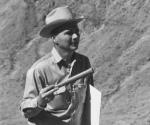 Eugene Shoemaker: 1928-1997
15.01.1998
Eugene Shoemaker's passion was Astrogeology. He dreamed of going to the Moon. Credited with inventing the branch of Astrogeology within the U.S. Geological Survey, his contributions to the field and the study of impact craters, lunar science, asteroids, and comets are legendary.
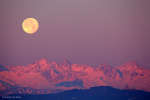 Alpine Superga Moonset
8.12.2017
December's Full Moon phase occurred near perigee, the closest point in its orbit around our fair planet. Big and bright, the fully illuminated lunar disk sets over rugged mountains in this early morningscape from Turin, Italy.
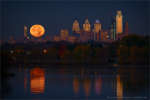 Philadelphia Perigee Full Moon
18.11.2016
A supermoon sets over the metropolis of Philadelphia in this twilight snapshot captured on November 14 at 6:21am Eastern Standard Time. Within hours of the Moon's exact full phase, that time does correspond to a lunar perigee or the closest point in the Moon's elliptical orbit around our fair planet.
 The Long Night Moon
20.12.2024
On the night of December 15, the Full Moon was bright. Known to some as the Cold Moon or the Long Night Moon, it was the closest Full Moon to the northern winter solstice and the last Full Moon of 2024. This Full Moon was also at a major lunar standstill.
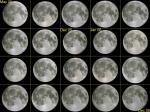 Twenty Full Moons
3.01.2007
In celebration of tonight's Full Moon, the first of 2007, consider this grid of twenty Full Moons. From upper left to lower right, the images represent every lunation from May 2005 through December 2006.
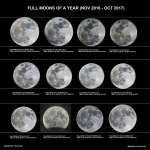 A Year of Full Moons
5.11.2017
Do all full moons look the same? No. To see the slight differences, consider this grid of twelve full moons. From upper left to lower right, the images represent every lunation from 2016 November through 2017 October, as imaged from Pakistan.
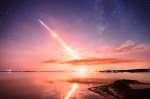 LADEE Launch Streak
11.09.2013
On September 6, a starry night and the Milky Way witnessed the launch of a Minotaur V rocket from NASA's Wallops Flight Facility on Wallops Island, Virginia. So did a large part of the eastern United States, as the spectacular night launch was easily visible even from light polluted urban areas.
|
January February March April May June July August |
||||||||||||||||||||||||||||||||||||||||||||||||||||||||