
|
You entered: planetary system
 APOD: 2024 February 12 Б HFG1 & Abell 6: Planetary Nebulae
12.02.2024
Planetary nebulae like Heckathorn-Fesen-Gull 1 (HFG1) and Abell 6 in the constellation Cassiopeia are remnants from the last phase of a medium sized star like our Sun. In spite of their shapes, planetary nebulae have nothing in common with actual planets.
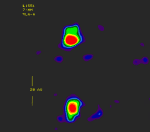 Twin Proto Planetary Disks
25.09.1998
Sun-like stars are forming - and probably planets too - hidden inside Lynds 1551, an interstellar cloud of molecular gas and dust in the constellation Taurus. Using new receivers, coordinated radio telescopes at the Very Large Array near Socorro, New Mexico, USA, can now sharply image the dusty proto-planetary disks surrounding these young stars at radio wavelengths.
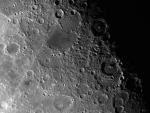 Impact Moon
26.03.1999
The Moon's surface is covered with craters, scars of frequent impacts during the early history of the solar system. Now, recent results from the Lunar Prospector spacecraft support the idea that the Moon itself formed from the debris of a giant impact of a mars-sized planetary body with the
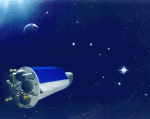 Searching For Solar Systems
15.11.1996
Observational astronomy has recently provided evidence of the existence of massive Jupiter-sized planets orbiting distant suns, protoplanetary disks of gas and dust surrounding newly formed stars, and planetary bodies orbiting exotic stellar corpses known as pulsars. Indeed, the formation of planets seems to be a broader and more varied phenomenon than previously imagined.
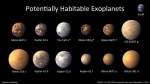 Habitable Worlds
3.03.2014
Is Earth the only known world that can support life? In an effort to find life-habitable worlds outside our Solar System, stars similar to our Sun are being monitored for slight light decreases that indicate eclipsing planets. Many previously-unknown planets are being found, including over 700 worlds recently uncovered by NASA's Kepler satellite.
 Planets In The Sun
5.05.2000
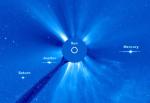
Today, all five naked-eye planets (Mercury, Venus, Mars, Jupiter, Saturn) plus the Moon and the Sun will at least approximately line-up. As viewed from planet Earth, they will be clustered within about 26 degrees, the closest alignment for all these celestial bodies since February 1962, when there was a solar eclipse!
 NGC 3242: The Ghost of Jupiter
29.10.2005
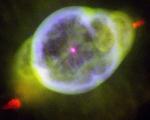
After a star like the Sun completes fusion in its core, it throws off its outer layers in a brief, beautiful cosmic display called a planetary nebula. NGC 3242 is such a planetary nebula, with the stellar remnant white dwarf star visible at the center.
 The Comet, the Owl, and the Galaxy
21.04.2016
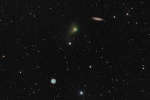
Comet C/2014 S2 (PanSTARRS) poses for a Messier moment in this telescopic snapshot from April 18. In fact it shares the 1.5 degree wide field-of-view with two well-known entries in the 18th century comet-hunting astronomer's famous catalog.
 Density Waves in Saturns Rings from Cassini
8.08.2017
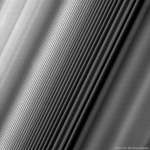
What causes the patterns in Saturn's rings? The Cassini spacecraft, soon ending its 13 years orbiting Saturn, has sent back another spectacular image of Saturn's immense ring system in unprecedented detail. The physical cause for some of Saturn's ring structures is not always understood.
 A Spectrum of Nova Delphini
23.08.2013
When a new star appeared in the constellation Delphinus late last week, astronomers found its spectrum hinted at the apparition's true nature. Now known as Nova Delphini, its visible light spectrum near maximum...
|
January February March April May June July August September |
|||||||||||||||||||||||||||||||||||||||||||||||||