
|
You entered: pole
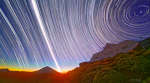 APOD: 2026 March 20 Б Spring Equinox at Teide Observatory
19.03.2026
The defining astronomical moment of the equinox today is at 14:46 UTC (March 20). That's when the Sun crosses the celestial equator moving north in its yearly journey through planet Earth's sky, marking the beginning of spring for our fair planet in the northern hemisphere and fall in the southern hemisphere.
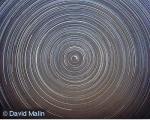 Star Trails in Northern Skies
12.09.1998
As the Earth spins on its axis, the sky seems to rotate around us. This motion produces the beautiful concentric trails traced by the stars in this time exposure of the night sky.
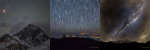 Highest, Tallest, and Closest to the Stars
24.02.2016
Fans of planet Earth probably recognize its highest mountain, the Himalayan Mount Everest, on the left in this 3-panel skyscape of The World at Night. Shrouded in cloud Everest's peak is at 8,848 meters (29,029 feet) elevation above sea level.
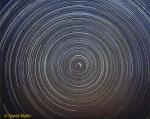 Star Trails in Northern Skies
30.11.1996
As the Earth spins on its axis, the sky seems to rotate around us. This motion produces the beautiful concentric arcs traced out by the stars in this time exposure of the night sky.
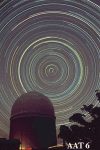 Star Trails in Southern Skies
25.09.1995
As the Earth spins on its axis, the sky seems to rotate around us. This motion produces the beautiful concentric arcs traced out by the stars in this time exposure of the night sky. In the foreground of the picture is the dome of the Anglo-Australian Telescope in central New South Wales Australia.
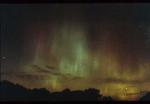 The Case of the Missing Aurora
21.10.1998
Sometimes, near midnight, auroras suddenly stop. Nobody knows why. This nightside gap in aurora was confirmed recently by D. Chua (U. Washington) and colleagues in data from the Ultraviolet Imager onboard the Polar spacecraft.
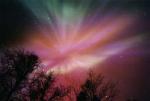 Aurora Above
10.11.1998
On some nights the sky is the most interesting show in town. This picture captures a particularly active and colorful display of aurora that occurred a month ago high above Alaska. Auroras are more commonly seen by observers located near the Earth's poles.
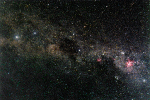 The Milky Way Near the Southern Cross
3.05.1996
This breathtaking patch of sky would be above you were you to stand at the south pole of the Earth. Just above and to the right of the photograph's center are the four stars that mark the boundaries of the famous Southern Cross.
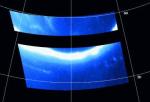 An Auroral Ring on Jupiter
9.06.1997
Do other planets have aurora? Terrestrial and spacecraft observations have found evidence for aurora on Venus, Mars, Jupiter, Saturn, Uranus, and Neptune. In the above false-color photograph, a good portion of an auroral ring was captured recently in optical light by the Galileo spacecraft in orbit around Jupiter.
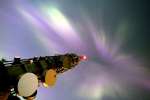 Auroral Corona Over Norway
31.01.2009
Higher than highest communications tower, higher than highest mountain, higher than highest airplane, lies the realm of the aurora. Auroras rarely reach below 60 kilometers, and can range up to 1000 kilometers. Aurora light results from energetic electrons and protons striking molecules in the Earth's atmosphere.
|
January February March April May June July August |
||||||||||||||||||||||||||||||||||||||||||||||||||||||||