
|
You entered: young stars
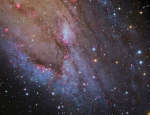 NGC 206 and the Star Clouds of Andromeda
25.09.2014
The large stellar association cataloged as NGC 206 is nestled within the dusty arms of the neighboring Andromeda galaxy. Also known as M31, the spiral galaxy is a mere 2.5 million light-years away.
 NGC 6822: Barnard s Galaxy
2.12.2021
Grand spiral galaxies often seem to get all the glory, flaunting their young, bright, blue star clusters in beautiful, symmetric spiral arms. But small galaxies form stars too, like nearby NGC 6822, also known as Barnard's Galaxy.
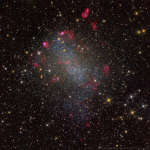 NGC 6822: Barnard s Galaxy
28.11.2020
Grand spiral galaxies often seem to get all the glory, flaunting their young, bright, blue star clusters in beautiful, symmetric spiral arms. But small galaxies form stars too, like nearby NGC 6822, also known as Barnard's Galaxy.
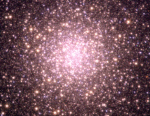 Globular Cluster M3
19.07.1998
This huge ball of stars predates our Sun. Long before mankind evolved, before dinosaurs roamed, and even before our Earth existed, ancient globs of stars condensed and orbited a young Milky Way Galaxy.
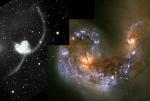 The Antennae Galaxies
22.10.1997
A ground-based telescopic view (left) of the collision between the galaxies NGC4038 and NGC4039 reveals long arcing insect-like "antennae" of luminous matter flung from the scene of the accident. Investigators using the Hubble Space...
 Young Suns
19.02.2000
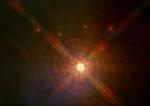
The star cataloged as NGC2264 IRS is normally hidden from the inquiring gaze of optical telescopes. It resides in the midst of the obscuring gas and dust of a nearby star forming region popularly known as the Cone Nebula.
 Spitzer s Orion
10.04.2010
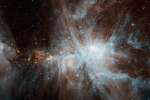
Few cosmic vistas excite the imagination like the Orion Nebula, an immense stellar nursery some 1,500 light-years away. Spanning about 40 light-years across the region, this new infrared image from the Spitzer Space...
 Celestial Fireworks: Into Star Cluster Westerlund 2
4.07.2017
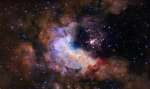
What if you could go right into a cluster where stars are forming? A one-minute, time-lapse, video visualization of just this has been made with 3D computer modeling of the region surrounding the star cluster Westerlund 2, based on images from the Hubble Space Telescope in visible and infrared light.
 In the Center of the Omega Nebula
8.02.2004
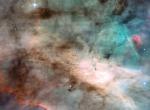
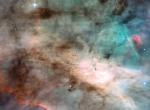
In the depths of the dark clouds of dust and molecular gas known as the Omega Nebula, stars continue to form. The above image from the Hubble Space Telescope's Advanced Camera for Surveys shows exquisite detail in the famous star-forming region.
 In the Center of the Omega Nebula
1.05.2002
In the depths of the dark clouds of dust and molecular gas known as the Omega Nebula, stars continue to form. The above image from the Hubble Space Telescope's newly installed Advanced Camera for Surveys shows unprecedented detail in the famous star-forming region.
|
January February March April May June July August September October |
|||||||||||||||||||||||||||||||||||||||||||||||||