
|
You entered: nearest stars
 Runaway Star
3.12.1997
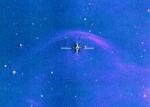
Runaway stars are massive stars traveling rapidly through interstellar space. Like a ship plowing through the interstellar medium, runaway star HD 77581 has produced this graceful arcing bow wave or "bow shock" - compressing the gaseous material in its path.
 Runaway Star
27.11.1999
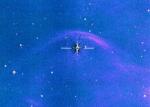
Runaway stars are massive stars traveling rapidly through interstellar space. Like a ship plowing through the interstellar medium, runaway star HD 77581 has produced this graceful arcing bow wave or "bow shock" - compressing the gaseous material in its path.
 A Dark and Stormy Night
31.10.2003
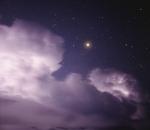
It was a dark and stormy night. But on August 29th the red planet Mars, near it's closest approach to Earth in almost 60,000 years, shone brightly in the sky against a background of stars in the constellation Aquarius.
 APOD: 2026 February 4 Б Spiral Galaxy NGC 1512: Wide Field
4.02.2026
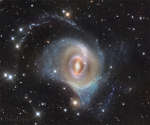
Most galaxies don't have any rings -- why does this galaxy have three? To begin, a ring that's near NGC 1512's center -- and so hard to see here -- is the nuclear ring which glows brightly with recently formed stars.
 Betelgeuse, Betelgeuse, Betelgeuse
5.06.1999
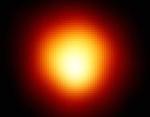
Betelgeuse (sounds a lot like "beetle juice"), a red supergiant star about 600 light years distant, is seen in this Hubble Space Telescope image - the first direct picture of the surface of a star other than the Sun. While Betelgeuse is cooler than the Sun, it is more massive and over 1000 times larger.
 Mojave Desert Fireball
17.12.2009
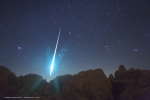
Monstrously bright, this fireball meteor lit up the Mojave Desert sky Monday morning, part of this year's impressive Geminid meteor shower. Seen toward the southwest over rock formations near Victorville, California, a more familiar celestial background was momentarily washed out by the meteor's flash.
 Sunspot Region 30
18.07.2002
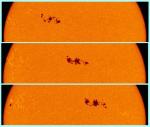
The solar active region designated number 0030 is now appearing on the visible hemisphere of the closest star. Dwarfed by the Sun's disk, the group of sunspots which make up region 30 actually cover an enormous area -- nearly 10 times the size of Earth.
 Stars and Lightning Over Greece
3.07.2013
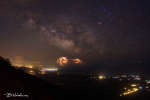
It may appear, at first, like the Galaxy is producing the lightning, but really it's the Earth. In the foreground of the above picturesque nighttime landscape is the Greek Island of Corfu, with town lights surrounding Lake Korrision. Visible farther in the distance are lights from the town of Preveza on the Greek mainland.
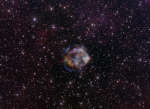 Cas A: Optical and X ray
17.01.2013
The aftermath of a cosmic cataclysm, supernova remnant Cassiopeia A (Cas A) is a comfortable 11,000 light-years away. Light from the Cas A supernova, the death explosion of a massive star, first reached Earth just 330 years ago.
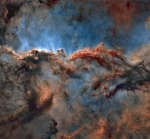 APOD: 2024 June 19 Б NGC 6188: Dragons of Ara
19.06.2024
Do dragons fight on the altar of the sky? Although it might appear that way, these dragons are illusions made of thin gas and dust. The emission nebula NGC 6188, home to the glowing...
|
January February March April May June July August September |
|||||||||||||||||||||||||||||||||||||||||||||||||