
|
You entered: surface
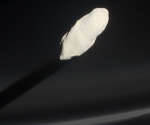 Prometheus Rising Through Saturns F Ring
19.10.2010
What is that dark streak below Prometheus? Although it may look like a shadow or a trail blazed by sweeping up material, computer simulations indicate that the dark streak is better understood as an empty path pulled away by the gravity of Saturn's small moon.
 Yogi and Friends in 3D
10.05.2025
This picture from July 1997 shows a ramp from the Pathfinder lander, the Sojourner robot rover, deflated landing airbags, a couch, Barnacle Bill and Yogi Rock appear together in this 3D stereo view of the surface of Mars. Barnacle Bill is the rock just left of the house cat-sized, solar-paneled Sojourner.
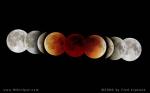 Third Millennium, First Eclipse
4.01.2001
The first eclipse of the third millennium is coming up! A total lunar eclipse mainly visible from Europe, Asia, and Africa, will occur on January 9th as the full Moon glides through the long, but not so dark shadow of planet Earth. Why not so dark?
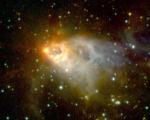 AFGL 2591: A Massive Star Acts Up
29.08.2001
Young star AFGL 2591 is putting on a show. The massive star is expelling outer layers of dust-laced gas as gravity pulls inner material toward the surface. AFGL 2591 is estimated to be about...
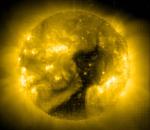 Coronal Hole
7.02.2002
This ominous, dark shape sprawling across the face of the active Sun is a coronal hole -- a low density region extending above the surface where the solar magnetic field opens freely into interplanetary space.
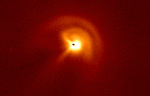 The Rotating Jets of Comet Hyakutake
14.04.1996
Comet Hyakutake will reach its closest point to the Sun on May 1, passing well inside the orbit of Mercury. At this time, the comet's dust and ion tail will be at their greatest physical length.
 Large Sunspot Groups 10484 and 10486
27.10.2003
Two unusually large sunspot groups are now crossing the face of the Sun. Each group, roughly the size of Jupiter, is unusual not only for its size but because it is appearing over three years after solar maximum, the peak of solar surface activity.
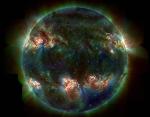 Dark Sun Sizzling
10.07.2006
Is this our Sun? Yes. Even on a normal day, our Sun is sizzling ball of seething hot gas. Unpredictably, regions of strong and tangled magnetic fields arise, causing sunspots and bright active regions. The Sun's surface bubbles as hot hydrogen gas streams along looping magnetic fields.
 Victoria Crater on Mars
2.10.2006
Scroll right to see the largest crater yet visited by a rover on Mars. Reaching the expansive Victoria Crater has been a goal for the robotic Opportunity rover rolling across Mars for the past 21 months. Opportunity reached Victoria last week, and is cautiously probing the stadium-sized crevice.
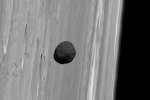 Martian Moon Phobos from Mars Express
1.12.2010
Why is Phobos so dark? Phobos, the largest and innermost of two Martian moons, is the darkest moon in the entire Solar System. Its unusual orbit and color indicate that it may be a captured asteroid composed of a mixture of ice and dark rock.
|
January February March April May June July August September October |
|||||||||||||||||||||||||||||||||||||||||||||||||