
|
You entered: telescope
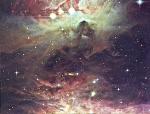 Reflections Of Orion
15.01.1999
The Orion Nebula and its surroundings present skygazers with a wondrous jumble of newborn stars, gas, and dust. Emission nebulae - glowing energized clouds of gas, and reflection nebulae - dust clouds shining by reflected starlight, abound at this photogenic cosmic location a mere 1,500 light-years or so away.
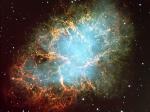 The Crab Nebula from VLT
22.11.1999
The Crab Nebula, filled with mysterious filaments, is the result of a star that was seen to explode in 1054 AD. This spectacular supernova explosion was recorded by Chinese and (quite probably) Anasazi Indian astronomers.
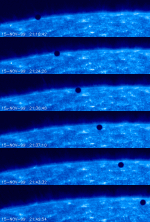 Mercury And The Sun
19.11.1999
Just days before the peak of the Leonid meteor shower, skywatchers were offered another astronomical treat as planet Mercury crossed the face of the Sun on November 15. Viewed from planet Earth, a transit of Mercury is not all that rare. The last occurred in 1993 and the next will happen in 2003.
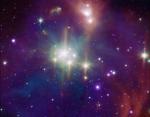 Coronet in the Southern Crown
21.09.2007
X-rays from young stars and infrared light from stars and cosmic dust are combined in this false color image of a star-forming region in Corona Australis, the Southern Crown. The small star grouping is fittingly known as the Coronet Cluster.
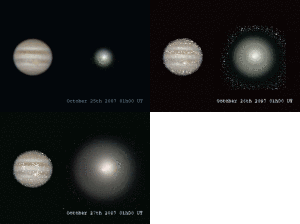 Comet Holmes Coma Expands
30.10.2007
Go outside tonight and see Comet Holmes. No binoculars or telescopes are needed -- just curiosity and a sky map. Last week, Comet 17P/Holmes underwent an unusual outburst that vaulted it unexpectedly from obscurity into one of the brightest comets in recent years.
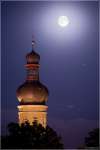 A Galilean Night
23.10.2009
Driving along on a summer evening, near the small town of Weikersheim in southern Germany, photographer Jens Hackmann had to stop. He couldn't resist pointing his camera and telephoto lens at this lovely conjunction of a Full Moon and planet Jupiter looming near the steeple of a local church.
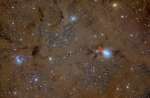 Stardust in Perseus
4.02.2010
This cosmic expanse of dust, gas, and stars covers close to 3 degrees on the sky in the heroic constellation Perseus. Right of center in the gorgeous skyscape is the dusty blue reflection nebula NGC 1333, about 1,000 light-years away. At that estimated distance, the field of view is about 50 light-years across.
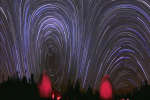 Warped Sky: Star Trails Panorama
11.07.2010
What's happened to the sky? A time warp, of sorts, and a digital space warp too. The time warp occurs because this image captured in a single frame a four hour exposure of the night sky. As a result, prominent star trails are visible.
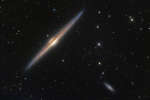 NGC 4565: Galaxy on Edge
15.10.2011
Magnificent spiral galaxy NGC 4565 is viewed edge-on from planet Earth. Also known as the Needle Galaxy for its narrow profile, bright NGC 4565 is a stop on many telescopic tours of the northern sky, in the faint but well-groomed constellation Coma Berenices.
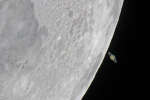 The Moons Saturn
7.04.2013
Just days after sharing the western evening sky with Venus in 2007, the Moon moved on to Saturn - actually passing in front of the ringed planet Saturn when viewed in skies over Europe, northern Africa, and western Asia.
|
January February March April May June July August September October |
|||||||||||||||||||||||||||||||||||||||||||||||||