
|
You entered: Earth's moon
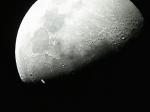 International Space Station in Transit
9.05.2003
A stunning telescopic image of the International Space Station crossing in front of an eight day old Moon, this picture was captured on April 11th. But while Wednesday's leisurely transit of Mercury across the Sun entertained observers all over the dayside of planet Earth, the audience for this lunar transit was more restricted.
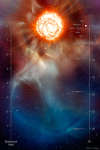 Betelgeuse Imagined
1.01.2020
Why is Betelgeuse fading? No one knows. Betelgeuse, one of the brightest and most recognized stars in the night sky, is only half as bright as it used to be only five months ago.
 APOD: 2023 October 1 Б A Desert Eclipse
1.10.2023
A good place to see a ring-of-fire eclipse, it seemed, would be from a desert. In a desert, there should be relatively few obscuring clouds and trees. Therefore late December of 2019, a group...
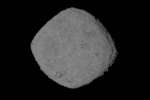 Rotating Asteroid Bennu from OSIRIS REx
13.11.2018
Could this close-by asteroid ever hit the Earth? Eventually yes -- but probably not for a very long time, even though the asteroid is expected to pass inside the orbit of the Moon next century.
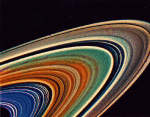 The Rings of Saturn
30.07.1995
Saturn's spectacular system of bright rings has been the subject of study and wonder since Galileo first turned his telescope on the ringed planet in 1610. To Galileo, the blurry image produced by his small telescope was confusing. Saturn appeared to him to have "ear-like" appendages which he thought might be large moons.
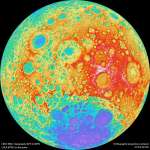 A Colorful Side of the Moon
18.11.2011
This colorful topographical map of the Moon is centered on the lunar farside, the side not seen from planet Earth. That view is available to the Lunar Reconnaissance Orbiter though, as the spacecraft's wide angle camera images almost the entire lunar surface every month.
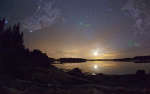 Moonset Over Pleasant Bay
29.03.2010
It was a sky for the imagination. In the early evening last week, the sky illuminating the unaided eye was perhaps even more illuminating to the mind's eye. The unaided eye saw clouds...
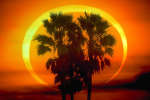 Annular Eclipse: The Ring of Fire
25.01.2009
Tomorrow, a few lucky people may see a "ring of fire." That's a name for the central view of an annular eclipse of the Sun by the Moon. At the peak of this...
 Annular Eclipse: The Ring of Fire
10.06.2002
Today, a few lucky people will see a "ring of fire." That's a name for the central view of an annular eclipse of the Sun by the Moon. At the peak of this...
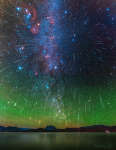 Geminids from Gemini
16.11.2021
Where are all of these meteors coming from? In terms of direction on the sky, the pointed answer is the constellation of Gemini. That is why the major meteor shower in December is known as the Geminids -- because shower meteors all appear to come from a radiant toward Gemini.
|
January February March April May June July August September |
|||||||||||||||||||||||||||||||||||||||||||||||||