
|
You entered: Milky Way
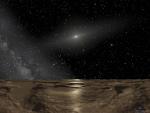 Sedna at Noon
4.06.2004
Standing on Sedna - the solar system's most distant known planetoid - your view of the Sun at high noon might look something like this. An artist's dramatic vision, the picture shows the Sun suspended above the nearby horizon as a bright star immersed in the dusty ecliptic plane.
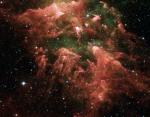 Sculpting the South Pillar
2.06.2005
Eta Carinae, one of the most massive and unstable stars in the Milky Way Galaxy, has a profound affect on its environment. Found in the the South Pillar region of the Carina Nebula, these...
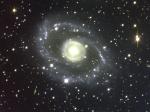 Spiral Galaxy In Centaurus
27.01.2000
Centaurus, the Centaur, is one of the most striking constellations in the southern sky. The lovely Milky Way flows through this large constellation whose celestial wonders also include the closest star to the sun, Alpha Centauri, the largest globular star cluster in our galaxy, Omega Centauri, and the closest active galaxy, Centaurus A.
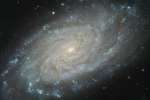 Spiral Galaxy NGC 3370 from Hubble
12.10.2008
Is this what our own Milky Way Galaxy looks like from far away? Similar in size and grand design to our home Galaxy (although without the central bar), spiral galaxy NGC 3370 lies about 100 million light-years away toward the constellation of the Lion (Leo).
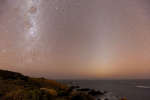 Zodiacal Light Over Laguna Verde
29.10.2009
An unusual triangle of light is visible this time of year just before dawn, in the northern hemisphere. Once considered a false dawn, this triangle of light is actually Zodiacal Light, light reflected from interplanetary dust particles.
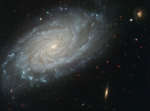 Spiral Galaxy NGC 3370 from Hubble
29.10.2011
Is this what our own Milky Way Galaxy looks like from far away? Similar in size and grand design to our home Galaxy (although without the central bar), spiral galaxy NGC 3370 lies about 100 million light-years away toward the constellation of the Lion (Leo).
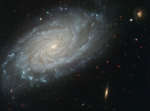 NGC 3370: A Sharper View
8.08.2013
Similar in size and grand design to our own Milky Way, spiral galaxy NGC 3370 lies about 100 million light-years away toward the constellation Leo. Recorded here in exquisite detail by the Hubble Space...
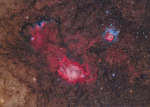 A Sagittarius Triplet
30.08.2013
These three bright nebulae are often featured in telescopic tours of the constellation Sagittarius and the crowded starfields of the central Milky Way. In fact, 18th century cosmic tourist Charles Messier cataloged two of them; M8, the large nebula left of center, and colorful M20 on the right.
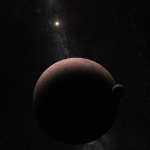 Moon over Makemake
30.04.2016
Makemake, second brightest dwarf planet of the Kuiper belt, has a moon. Nicknamed MK2, Makemake's moon reflects sunlight with a charcoal-dark surface, about 1,300 times fainter than its parent body. Still...
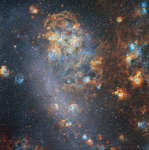 Shell Game in the LMC
29.12.2016
An alluring sight in southern skies, the Large Magellanic Cloud (LMC) is seen here through narrowband filters. The filters are designed to transmit only light emitted by ionized sulfur, hydrogen, and oxygen atoms. Ionized...
|
January February March April May June July August September October |
|||||||||||||||||||||||||||||||||||||||||||||||||