
|
You entered: constellation
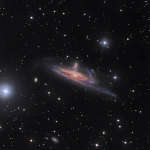 Galaxies in the River
8.01.2020
Large galaxies grow by eating small ones. Even our own galaxy engages in a sort of galactic cannibalism, absorbing small galaxies that are too close and are captured by the Milky Way's gravity.
 APOD: 2024 January 31 Б Camera Orion Rising
31.01.2024
What does Orion rising look like to a camera? During this time of the year, the famous constellation is visible to the southeast just after sunset. From most Earthly locations, Orion's familiar star pattern, highlighted by the three-stars-in-a-row belt stars, rises sideways.
 APOD: 2024 May 22 Б Green Aurora over Sweden
22.05.2024
It was bright and green and stretched across the sky. This striking aurora display was captured in 2016 just outside of цstersund, Sweden. Six photographic fields were merged to create the featured panorama spanning almost 180 degrees. Particularly striking aspects of this aurora include its sweeping arc-like shape and its stark definition.
 APOD: 2024 November 12 Б NGC 6888: The Crescent Nebula
12.11.2024
How was the Crescent Nebula created? Looking like an emerging space cocoon, the Crescent Nebula, visible in the center of the featured image, was created by the brightest star in its center. A leading progenitor hypothesis has the Crescent Nebula beginning to form about 250,000 years ago.
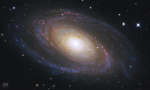 Messier 81
27.03.2025
One of the brightest galaxies in planet Earth's sky is similar in size to our Milky Way Galaxy: big, beautiful Messier 81. Also known as NGC 3031 or Bode's galaxy for its 18th century discoverer, this grand spiral can be found toward the northern constellation of Ursa Major, the Great Bear.
 APOD: 2025 June 17 Б Rosette Nebula Deep Field
17.06.2025
Can you find the Rosette Nebula? The red flowery-looking nebula just above the image center may seem a good choice, but that's not it. The famous Rosette Nebula is really located on the lower right, here colored blue and white, and connected to the other nebulas by gold-colored filaments.
 Portrait of NGC 1055
27.11.2025
Big, beautiful spiral galaxy NGC 1055 is a dominant member of a small galaxy group a mere 60 million light-years away toward the aquatically intimidating constellation Cetus. Seen edge-on, the island universe spans over 100,000 light-years, a little larger than our own Milky Way galaxy.
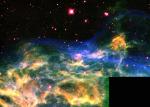 At the Edge of the Crescent Nebula
2.08.2000
The Crescent Nebula is a rapidly expanding shell of gas surrounding a dying star. In this recently released image by the Hubble Space Telescope, a bright dynamic part of the nebula three light-years across is shown in representative color.
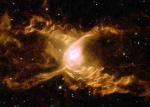 The Red Spider Planetary Nebula
24.07.2001
Oh what a tangled web a planetary nebula can weave. The Red Spider Planetary Nebula shows the complex structure that can result when a normal star ejects its outer gases and becomes a white dwarf star.
 The Deep Field
9.02.1997
Galaxies like colorful pieces of candy fill the Hubble Deep Field - humanity's most distant yet optical view of the Universe. The dimmest, some as faint as 30th magnitude (about four billion times fainter...
|
January February March April May June July August September October |
|||||||||||||||||||||||||||||||||||||||||||||||||