
|
You entered: Earth's moon
 Full Moons of August
30.08.2023
Near perigee, the closest point in its almost moonthly orbit, a Full Moon rose as the Sun set on August 1. Its brighter than average lunar disk was captured in this dramatic moonrise sequence over dense cloud banks along the eastern horizon from Ragusa, Sicily.
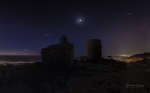 Five Planets at Castell de Burriac
6.02.2016
February's five planet line-up stretches across a clear sky in this predawn scene. A hilltop Castell de Burriac looms in the foreground, overlooking the town of Cabrera de Mar near Barcelona, Spain, planet Earth. The mosaicked, panoramic image looks south.
 The Leo Trio
21.03.2025
This popular group leaps into the early evening sky around the March equinox and the northern hemisphere spring. Famous as the Leo Triplet, the three magnificent galaxies found in the prominent constellation Leo gather here in one astronomical field of view.
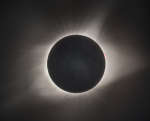 The Crown of the Sun
23.08.2017
During a total solar eclipse, the Sun's extensive outer atmosphere, or corona, is an inspirational sight. Streamers and shimmering features visible to the eye span a brightness range of over 10,000 to 1, making them notoriously difficult to capture in a single photograph.
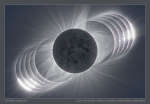 The Big Corona
1.07.2019
Most photographs don't adequately portray the magnificence of the Sun's corona. Seeing the corona first-hand during a total solar eclipse is unparalleled. The human eye can adapt to see coronal features and extent that average cameras usually cannot. Welcome, however, to the digital age.
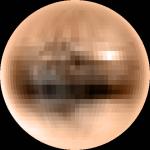 Pluto in True Color
19.03.2001
Pluto is mostly brown. The above picture captures the true colors of Pluto as well as the highest surface resolution so far recovered. No spacecraft has yet visited this most distant planet in our Solar System.
 Planet Earth from Orion
17.11.2022
A Space Launch System rocket left planet Earth on Wednesday, November 16 at 1:47am EST carrying the Orion spacecraft on the Artemis 1 mission, the first integrated test of NASAБs deep space exploration systems.
 The Big Corona
20.09.2017
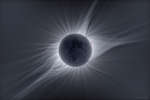
Most photographs don't adequately portray the magnificence of the Sun's corona. Seeing the corona first-hand during a total solar eclipse is unparalleled. The human eye can adapt to see coronal features and extent that average cameras usually cannot. Welcome, however, to the digital age.
 Pluto in True Color
3.09.2006
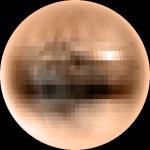
Pluto is mostly brown. The above picture captures the true colors of Pluto as well as the highest surface resolution so far recovered. Although no spacecraft has yet visited this distant world, the New Horizons spacecraft launched early this year is expected to reach Pluto in 2015.
 The Milky Way over St Michaels Mount
7.09.2020
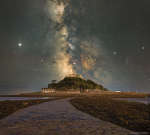
Where do land and sky converge? On every horizon -- but in this case the path on the ground leads to St Michael's Mount (Cornish: Karrek Loos yn Koos), a small historic island in Cornwall, England. The Mount is usually surrounded by shallow water, but at low tide is spanned by a human-constructed causeway.
|
January February March April May June July August September |
|||||||||||||||||||||||||||||||||||||||||||||||||