
|
You entered: star
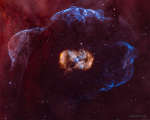 NGC 6164: Dragons Egg Nebula and Halo
26.12.2022
The star at the center created everything. Known as the Dragon's Egg, this star -- a rare, hot, luminous O-type star some 40 times as massive as the Sun -- created not only the complex nebula (NGC 6164) that immediately surrounds it, but also the encompassing blue halo.
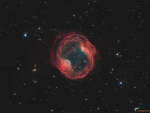 Jones Emberson 1
12.07.2024
Planetary nebula Jones-Emberson 1 is the death shroud of a dying Sun-like star. It lies some 1,600 light-years from Earth toward the sharp-eyed constellation Lynx. About 4 light-years across, the expanding remnant...
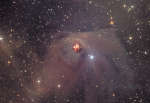 T Tauri and Hind s Variable Nebula
3.05.2014
The yellowish star near center in this dusty telescopic skyview is T Tauri, prototype of the class of T Tauri variable stars. Just next door is the yellow cosmic cloud historically known as Hind's Variable Nebula (NGC 1555).
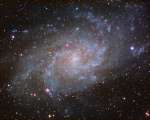 M33: Triangulum Galaxy
30.11.2017
The small, northern constellation Triangulum harbors this magnificent face-on spiral galaxy, M33. Its popular names include the Pinwheel Galaxy or just the Triangulum Galaxy. M33 is over 50,000 light-years in diameter, third largest in the Local Group of galaxies after the Andromeda Galaxy (M31), and our own Milky Way.
 Seven Dusty Sisters
28.05.2018
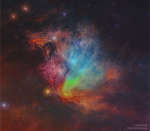
Is this really the famous Pleaides star cluster? Known for its iconic blue stars, the Pleaides is shown here in infrared light where the surrounding dust outshines the stars. Here three infrared colors have been mapped into visual colors (R=24, G=12, B=4.6 microns).
 Yosemite Winter Night
25.12.2012
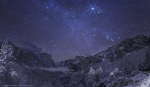
In this evocative night skyscape a starry band of the Milky Way climbs over Yosemite Valley, Sierra Nevada Range, planet Earth. Jupiter is the brightest celestial beacon on the wintry scene, though. Standing nearly opposite the Sun in the constellation Taurus, the wandering planet joins yellowish Aldebaran and the Hyades star cluster.
 M6: The Butterfly Cluster
3.09.2014
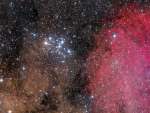
To some, the outline of the open cluster of stars M6 resembles a butterfly. M6, also known as NGC 6405, spans about 20 light-years and lies about 2,000 light years distant. M6, pictured...
 Near the Center of the Lagoon Nebula
4.11.2019
Stars are battling gas and dust in the Lagoon Nebula but the photographers are winning. Also known as M8, this photogenic nebula is visible even without binoculars towards the constellation of the Archer (Sagittarius). The energetic processes of star formation create not only the colors but the chaos.
 Facing NGC 6946
9.01.2012
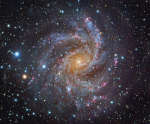
From our vantage point in the Milky Way Galaxy, we see NGC 6946 face-on. The big, beautiful spiral galaxy is located just 10 million light-years away, behind a veil of foreground dust and stars in the high and far-off constellation of Cepheus.
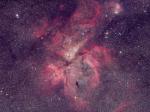 NGC 3372: The Great Nebula in Carina
17.05.2004
In one of the brightest parts of the Milky Way lies a nebula where some of the oddest things occur. NGC 3372, known as the Great Nebula in Carina, is home to massive stars and changing nebula.
|
January February March April May June July August September October |
|||||||||||||||||||||||||||||||||||||||||||||||||