
|
You entered: Earth orbit
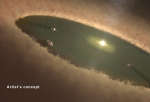 The Double Dust Disks of HD 95086
16.11.2014
What do other star systems look like? To help find out, astronomers are carrying out detailed observations of nearby stars in infrared light to see which have dust disks that might be forming planets.
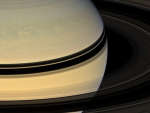 Saturns Rings from the Other Side
9.06.2008
What do Saturn's rings look like from the other side? From Earth, we usually see Saturn's rings from the same side of the ring plane that the Sun illuminates them. Geometrically...
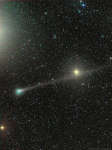 Rosetta s Comet in Gemini
13.11.2021
Returning along its 6.4 year orbit, periodic comet Churyumov-Gerasimenko (67P) is caught in this telescopic frame from November 7. Sweeping past background stars in the constellation Gemini the comet's dusty tail stretches toward the upper right to Upsilon Geminorum.
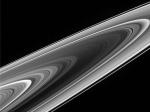 Saturns Rings from the Other Side
22.06.2005
What do Saturn's rings look like from the other side? From Earth, we usually see Saturn's rings from the same side of the ring plane that the Sun illuminates them. Geometrically...
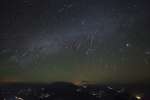 Geminid Meteor Shower over Dashanbao Wetlands
13.12.2013
The annual Geminid meteor shower is raining down on planet Earth this week. And despite the waxing gibbous moonlight, the reliable Geminids should be enjoyable tonight (night of December 13/14) near the shower's peak.
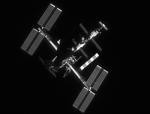 A Visit from Atlantis
28.06.2007
This remarkable image of the space shuttle orbiter Atlantis docked with the International Space Station (ISS) was taken at a range of 190 nautical miles. To record the fast moving pair, last week astronomers...
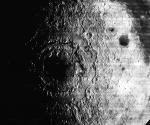 Mare Orientale
12.01.1996
Looking like a target ring bull's-eye, the Mare Orientale is one of the most striking large scale lunar features. Located on the Moon's extreme western edge, this impact basin is unfortunately difficult to see from an earthbound perspective.
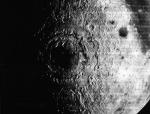 Mare Orientale
23.11.2002
Like a target ring bull's-eye, the Mare Orientale is one of the most striking large scale lunar features. Located on the Moon's extreme western edge, this impact basin is unfortunately difficult to see from an earthbound perspective.
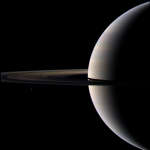 Saturn After Equinox
10.11.2009
The other side of Saturn's ring plane is now directly illuminated by the Sun. For the previous 15 years, the southern side of Saturn and its rings were directly illuminated, but since Saturn's equinox in August, the orientation has reversed.
 Most of Comet Tsuchinshan ATLAS
18.10.2024
On October 14 it was hard to capture a full view of Comet C/2023 A3 Tsuchinshan-ATLAS. Taken after the comet's closest approach to our fair planet, this evening skyview almost does though. With...
|
January February March April May June July August September October |
|||||||||||||||||||||||||||||||||||||||||||||||||