
|
You entered: apod
 Eclipse Street, Hong Kong
24.06.2020
On June 21 an annular solar eclipse came soon after the solstice and our fair planet's northernmost sunset for 2020. At maximum eclipse, the New Moon in silhouette created a ring of fire visible along a narrow path at most 85 kilometers wide.
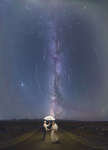 Perseid Rain
14.08.2021
Comet dust rained down on planet Earth last week, streaking through dark skies in the annual Perseid meteor shower. The featured picture is a composite of many images taken from the same location over the peak night of the Perseids.
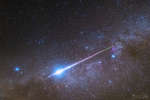 Bright Meteor, Starry Sky
18.08.2021
Plowing through Earth's atmosphere at 60 kilometers per second, this bright perseid meteor streaks along a starry Milky Way. Captured in dark Portugal skies on August 12, it moves right to left through the frame.
 The Moon from Zond 8
16.07.2013
Which moon is this? Earth's. Our Moon's unfamiliar appearance is due partly to an unfamiliar viewing angle as captured by a little-known spacecraft -- the Soviet Union's Zond 8 that circled the Moon in October of 1970.
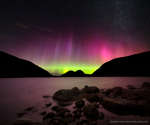 Aurora over Maine
17.09.2014
It has been a good week for auroras. Earlier this month active sunspot region 2158 rotated into view and unleashed a series of flares and plasma ejections into the Solar System during its journey across the Sun's disk.
 The Cartwheel Galaxy from Hubble
17.12.2016
To some, it looks like the wheel of a cart. In fact, because of its outward oval appearance, the presence of a central galaxy, and their connection with what looks like the spokes of a wheel, the galaxy on the right is known as the Cartwheel Galaxy.
 Aurora over Clouds
29.05.2021
Auroras usually occur high above the clouds. The auroral glow is created when fast-moving particles ejected from the Sun impact the Earth's magnetosphere, from which charged particles spiral along the Earth's magnetic field to strike atoms and molecules high in the Earth's atmosphere.
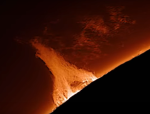 Eiffel Tower Prominence on the Sun
15.02.2022
What's that on the Sun? Although it may look like a flowing version of the Eiffel Tower, it is a solar prominence that is actually much bigger -- about the height of Jupiter.
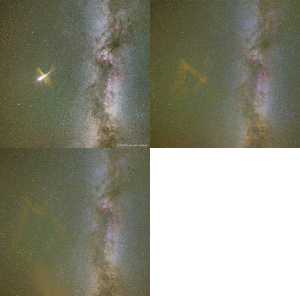 Milky Way and Exploding Meteor
5.08.2017
Next weekend the Perseid Meteor Shower reaches its maximum. Grains of icy rock will streak across the sky as they evaporate during entry into Earth's atmosphere. These grains were shed from Comet Swift-Tuttle.
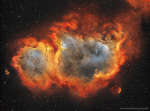 Glowing Elements in the Soul Nebula
20.08.2018
Stars are forming in the Soul of the Queen of Aethopia. More specifically, a large star forming region called the Soul Nebula (IC 1898) can be found in the direction of the constellation Cassiopeia, who Greek mythology credits as the vain wife of a King who long ago ruled lands surrounding the upper Nile river.
|
January February March April May June July August |
||||||||||||||||||||||||||||||||||||||||||||||||||||||||