
|
You entered: nearest stars
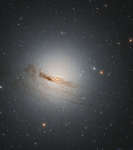 Threads of NGC 1947
7.04.2021
Found in far southern skies, deep within the boundaries of the constellation Dorado, NGC 1947 is some 40 million light-years away. In silhouette against starlight, obscuring lanes of cosmic dust thread across the peculiar galaxy's bright central regions.
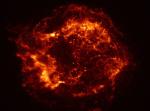 Chandras First Light: Cassiopeia A
27.08.1999
Cosmic wreckage from the detonation of a massive star is the subject of this official first image from NASA's Chandra X-ray Observatory. The supernova remnant, known as Cassiopeia A, was produced when a star exploded around 300 years ago in this northern sky constellation.
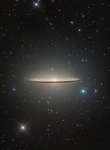 M104: The Sombrero Galaxy
14.05.2021
A gorgeous spiral galaxy, M104 is famous for its nearly edge-on profile featuring a broad ring of obscuring dust lanes. Seen in silhouette against an extensive central bulge of stars, the swath of cosmic dust lends a broad brimmed hat-like appearance to the galaxy suggesting a more popular moniker, the Sombrero Galaxy.
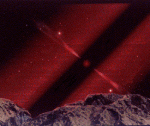 Planet Near a Galaxy Core
5.05.1996
What would the night sky look like if you lived on a planet near the center of a galaxy? Now imagine that this galaxy houses a black hole billions of times more massive than a star. From this spectacular vantage point, the sky might look like the above illustration.
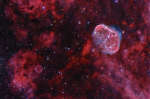 Cygnus: Bubble and Crescent
4.12.2015
These clouds of gas and dust drift through rich star fields along the plane of our Milky Way Galaxy toward the high flying constellation Cygnus. Caught within the telescopic field of view are the Soap Bubble (lower left) and the Crescent Nebula (upper right).
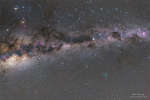 Close Comet and the Milky Way
25.03.2016
Comet 252P/Linear's lovely greenish coma is easy to spot in this expansive southern skyscape. Visible to the naked eye from the dark site near Flinders, Victoria, Australia, the comet appears tailless. Still, its surprisingly bright coma spans about 1 degree, posed here below the nebulae, stars, and dark rifts of the Milky Way.
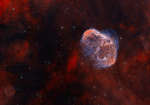 Cygnus: Bubble and Crescent
17.10.2020
These clouds of gas and dust drift through rich star fields along the plane of our Milky Way Galaxy toward the high flying constellation Cygnus. Caught within the telescopic field of view are the Soap Bubble (lower left) and the Crescent Nebula (upper right).
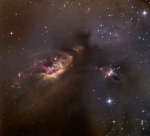 Sh2-239: Celestial Impasto
8.12.2011
The cosmic brush of star formation composed this alluring mix of dust and dark nebulae. Cataloged as Sh2-239 and LDN 1551, the region lies near the southern end of the Taurus molecular cloud complex some 450 light-years distant.
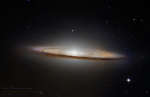 M104: The Sombrero Galaxy
29.03.2019
The striking spiral galaxy M104 is famous for its nearly edge-on profile featuring a broad ring of obscuring dust lanes. Seen in silhouette against an extensive central bulge of stars, the swath of cosmic dust lends a broad brimmed hat-like appearance to the galaxy suggesting a more popular moniker, The Sombrero Galaxy.
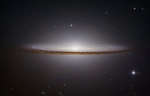 Messier 104
23.04.2022
A gorgeous spiral galaxy, Messier 104 is famous for its nearly edge-on profile featuring a broad ring of obscuring dust lanes. Seen in silhouette against an extensive central bulge of stars, the swath of cosmic dust lends a broad brimmed hat-like appearance to the galaxy suggesting a more popular moniker, the Sombrero Galaxy.
|
January February March April May June July August September |
|||||||||||||||||||||||||||||||||||||||||||||||||