
|
You entered: Milky Way
 APOD: 2024 October 13 Б Aurora Timelapse Over Italian Alps
12.10.2024
Did you see last night's aurora? This question was relevant around much of the world a few days ago because a powerful auroral storm became visible unusually far from the Earth's poles.
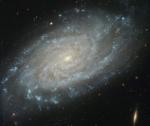 NGC 3370: A Sharper View
11.09.2003
Similar in size and grand design to our own Milky Way, spiral galaxy NGC 3370 lies about 100 million light-years away toward the constellation Leo. Recorded here in exquisite detail by the Hubble Space...
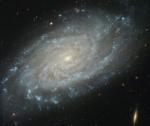 NGC 3370: A Sharper View
14.05.2005
Similar in size and grand design to our own Milky Way, spiral galaxy NGC 3370 lies about 100 million light-years away toward the constellation Leo. Recorded here in exquisite detail by the Hubble Space...
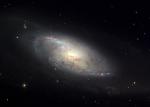 M106 in Canes Venatici
30.07.2005
Close to the Great Bear (Ursa Major) and surrounded by the stars of the Hunting Dogs (Canes Venatici), this celestial nebula was discovered in 1781 by the metric French astronomer Pierre Mechain. Later, it was added to the catalog of his friend and colleague Charles Messier as M106.
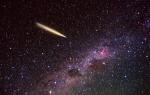 Mystery Over Australia
21.02.2007
Place your cursor on this stunning view of dark skies over western Australia to highlight wonders of the southern Milky Way -- including the famous Southern Cross, the dark Coal Sack Nebula, and bright reddish emission regions surrounding massive star Eta Carinae.
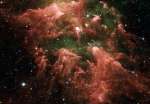 Sculpting the South Pillar
12.03.2008
Eta Carinae, one of the most massive and unstable stars in the Milky Way Galaxy, has a profound effect on its environment. Found in the the South Pillar region of the Carina Nebula, these...
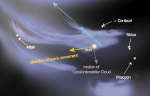 The Local Fluff
29.08.2010
The stars are not alone. In the disk of our Milky Way Galaxy about 10 percent of visible matter is in the form of gas, called the interstellar medium (ISM). The ISM is not uniform, and shows patchiness even near our Sun.
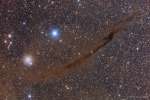 NGC 4372 and the Dark Doodad
31.01.2013
The delightful Dark Doodad Nebula drifts through southern skies, a tantalizing target for binoculars in the constellation Musca, The Fly. The dusty cosmic cloud is seen against rich starfields just south of the prominent Coalsack Nebula and the Southern Cross.
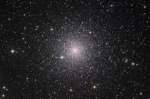 Globular Star Cluster NGC 6752
5.07.2013
Some 13,000 light-years away toward the southern constellation Pavo, the globular star cluster NGC 6752 roams the halo of our Milky Way galaxy. Over 10 billion years old, NGC 6752 follows clusters Omega Centauri and 47 Tucanae as the third brightest globular in planet Earth's night sky.
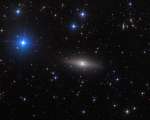 NGC 7814: The Little Sombrero in Pegasus
25.10.2013
Point your telescope toward the high flying constellation Pegasus and you can find this expanse of Milky Way stars and distant galaxies. Centered on NGC 7814, the pretty field of view would almost be covered by a full moon.
|
January February March April May June July August September October |
|||||||||||||||||||||||||||||||||||||||||||||||||