
|
You entered: massive stars
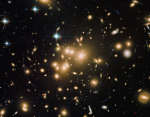 Galaxy Cluster Abell 1689 Deflects Light
17.09.2013
It is one of the most massive objects in the visible universe. In this view from the Hubble Space Telescope's Advanced Camera for Surveys, Abell 1689 is seen to warp space as predicted by Einstein's theory of gravity -- deflecting light from individual galaxies which lie behind the cluster to produce multiple, curved images.
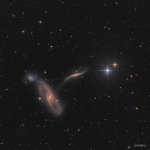 Arp 286: Trio in Virgo
10.06.2022
This colorful telescopic field of view features a trio of interacting galaxies almost 90 million light-years away, toward the constellation Virgo. On the right two spiky, foreground Milky Way stars echo the extragalactic hues, a reminder that stars in our own galaxy are like those in distant island universes.
 Aurora Australis
4.07.2015
Not fireworks, these intense shimmering lights still danced across Earth's night skies late last month, seen here above the planet's geographic south pole. The stunning auroral displays were triggered as a coronal mass ejection blasted from the Sun days earlier impacted the magnetosphere, beginning a widespread geomagnetic storm.
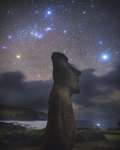 Orion above Easter Island
18.09.2017
Why were the statues on Easter Island built? No one is sure. What is sure is that over 800 large stone statues exist there. The Easter Island statues, stand, on the average, over twice as tall as a person and have over 200 times as much mass.
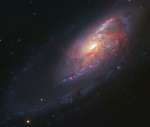 The Arms of M106
6.02.2013
The spiral arms of bright galaxy M106 sprawl through this remarkable multiframe portrait, composed of data from ground- and space-based telescopes. Also known as NGC 4258, M106 can be found toward the northern constellation Canes Venatici. The well-measured distance to M106 is 23.5 million light-years, making this cosmic scene about 80,000 light-years across.
 Northern Lights, September Skies
16.09.2005
So far, the Aurora Borealis or Northern Lights have made some remarkable visits to September's skies. The reason, of course, is the not-so-quiet Sun. In particular, a large solar active region now crossing...
 M106 in Canes Venatici
30.07.2005
Close to the Great Bear (Ursa Major) and surrounded by the stars of the Hunting Dogs (Canes Venatici), this celestial nebula was discovered in 1781 by the metric French astronomer Pierre Mechain. Later, it was added to the catalog of his friend and colleague Charles Messier as M106.
 M106 in Canes Venatici
17.04.2003
Close to the Great Bear (Ursa Major) and surrounded by the stars of the Hunting Dogs (Canes Venatici), this celestial nebula was discovered in 1781 by the metric French astronomer Pierre Mechain and later added to the catalog of his friend and colleague Charles Messier as M106.
 M104: The Sombrero Galaxy
8.02.1997
The famous Sombrero galaxy (M104) is a bright nearby spiral galaxy. The prominent dust lane and halo of stars and globular clusters give this galaxy its name. Something very energetic is going on in the Sombrero's center, as much X-ray light has been detected from it.
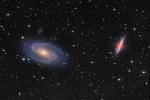 Galaxy Wars: M81 versus M82
15.04.2006
In this stunning cosmic vista, galaxy M81 is on the left surrounded by blue spiral arms. On the right marked by massive gas and dust clouds, is M82. These two mammoth galaxies have been locked in gravitational combat for the past billion years.
|
January February March April |
|||||||||||||||||||||||||||||||||||||||||||||||||