
|
You entered: Earth orbit
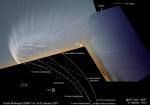 A Tail of Two Hemispheres
1.02.2007
By January 19/20 Comet McNaught's magnificent dust tail stretched for about 150 million kilometers (~1 AU), requiring images from both southern and northern hemispheres of planet Earth to take it all in.
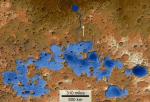 Carving Ma adim Vallis
27.06.2002
Just as erosion from the Colorado River carved the Grand Canyon on Earth, a river of flood water may have carved Ma'adim Vallis, one of the largest canyons on Mars. Researchers have presented...
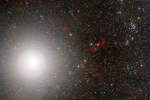 In the Glare of Alpha Centauri
28.06.2012
The glare of Alpha Centauri, one of the brightest stars in planet Earth's night sky, floods the left side of this southern skyscape. A mere 4.3 light-years distant, Alpha Centauri actually consists of two component stars similar in size to the Sun, locked in a mutual orbit.
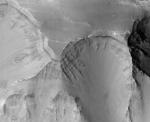 In A Grand Canyon On Mars
12.02.1998
In a grand canyon on Mars, steep slopes fall away from a smooth plateau revealing striking layered rock formations. The canyon is part of the Valles Marineris, a 2,500 mile long system of canyons cutting across the Martian equator.
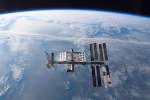 The International Space Station Expands Again
5.03.2008
The developing International Space Station (ISS) has changed its appearance again. Last month, the Space Shuttle orbiter Atlantis visited the ISS and added components that included the Columbus Science Laboratory. The entire array of expansive solar panels is visible in this picture taken by the Atlantis Crew after leaving the ISS to return to Earth.
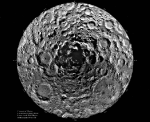 Shadow at the Lunar South Pole
28.11.1995
In 1994, the space probe Clementine spent 70 days in lunar orbit mapping the Moon's surface. Shown above is a dramatically detailed composite view centered on the Moon's South Pole constructed from 1500 Clementine images.
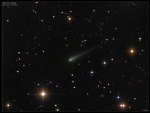 Comet ISON Approaches
7.10.2013
How impressive will Comet ISON become? No one is sure, but unfortunately, as the comet approaches the inner Solar System, it is brightening more slowly than many early predictions. Pictured above, Comet ISON is seen about two weeks ago as it continued to develop a tail.
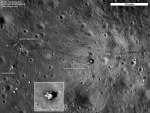 Apollo 17 Site: A Sharper View
8.09.2011
This view of the Apollo 17 landing site in the Taurus-Littrow valley was captured last month by the Lunar Reconnaissance Orbiter (LRO), the sharpest ever recorded from space. The high resolution image data...
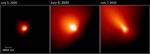 Comet LINEAR Breaks Up
31.07.2000
Unexpectedly, Comet LINEAR is breaking up. In retrospect, clues of its demise have been surfacing all month as the new comet has been approaching the Sun and brightening with dramatic flares. Above, the Hubble Space Telescope captured Comet C/1999 S4 LINEAR early this month blowing off a large piece of its crust.
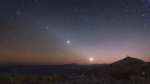 Planets of the Morning
26.11.2015
Planet Earth's horizon stretches across this recent Solar System group portrait, seen from the southern hemisphere's Las Campanas Observatory. Taken before dawn it traces the ecliptic with a line-up familiar to November's early morning risers.
|
January February March April May June July August September October |
|||||||||||||||||||||||||||||||||||||||||||||||||