
|
You entered: cluster
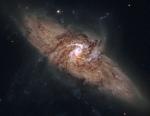 NGC 3314: When Galaxies Overlap
11.05.2000
Can this be a spiral galaxy? In fact, NGC 3314 consists of two large spiral galaxies which just happen to almost exactly line-up. The foreground spiral is viewed nearly face-on, its pinwheel shape defined by young bright star clusters.
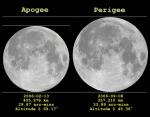 Apogee Moon, Perigee Moon
25.10.2007
Tonight, those blessed with clear skies can enjoy a glorious Full Moon, (exact full phase at 0452 UT, October 26). In fact, the Moon will reach its full phase within a few hours of perigee, the closest point in its elliptical orbit, making it the largest Full Moon of 2007.
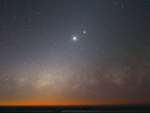 Chilean Skyscape
29.11.2008
Night skies over Chilean mountain top observatories can be dark and clear, with glorious cosmic vistas. In this recent example, the plane of our Milky Way galaxy stretches parallel to the horizon, the galactic center's star clusters, dark dust clouds, and glowing nebulae hovering in the west.
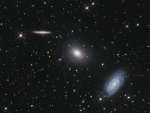 Three Galaxies in Draco
1.07.2009
This intriguing trio of galaxies is sometimes called the Draco Group, located in the northern constellation of (you guessed it) Draco. From left to right are edge-on spiral NGC 5981, elliptical galaxy NGC 5982...
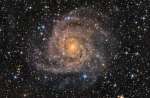 Hidden Galaxy IC 342
18.07.2013
Similar in size to large, bright spiral galaxies in our neighborhood, IC 342 is a mere 10 million light-years distant in the long-necked, northern constellation Camelopardalis. A sprawling island universe, IC 342 would otherwise...
 Sputnik Planum vs. Krun Macula
18.06.2016
Pluto's pitted plains meet rugged highlands in this stunning view. On the left lies a southeastern extent of the bright region still informally known as Sputnik Planum. At right the edge of a dark region, informally Krun Macula, rises some 2.5 kilometers above the icy plains.
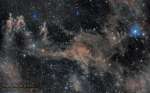 Stardust in Aries
9.12.2017
This composition in stardust covers over 8 degrees on the northern sky. The mosaicked field of view is west of the familiar Pleiades star cluster, toward the zodiacal constellation Aries and the plane of our Milky Way Galaxy.
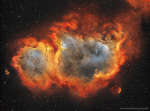 Glowing Elements in the Soul Nebula
21.08.2018
Stars are forming in the Soul of the Queen of Aethopia. More specifically, a large star forming region called the Soul Nebula (IC 1898) can be found in the direction of the constellation Cassiopeia, who Greek mythology credits as the vain wife of a King who long ago ruled lands surrounding the upper Nile river.
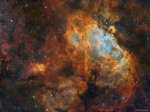 M16: In and Around the Eagle Nebula
15.10.2018
From afar, the whole thing looks like an Eagle. A closer look at the Eagle Nebula, however, shows the bright region is actually a window into the center of a larger dark shell of dust. Through this window, a brightly-lit workshop appears where a whole open cluster of stars is being formed.
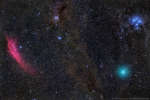 Red Nebula, Green Comet, Blue Stars
20.12.2018
This festively colored skyscape was captured in the early morning hours of December 17, following Comet Wirtanen's closest approach to planet Earth. The comet was just visible to the eye. The lovely green...
|
January February March April May June July August September October |
|||||||||||||||||||||||||||||||||||||||||||||||||