
|
You entered: spacecraft
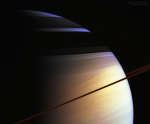 The Colors of Saturn from Cassini
30.03.2020
What creates Saturn's colors? The featured picture of Saturn only slightly exaggerates what a human would see if hovering close to the giant ringed world. The image was taken in 2005 by the robot Cassini spacecraft that orbited Saturn from 2004 to 2017.
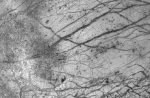 Galileo Explores Europa
14.08.1996
Details of the crazed cracks criss-crossing Europa's frozen surface are apparent in this mosaic of the Galileo spacecraft's latest images of Jupiter's ice-covered moon. Curious white stripes, also seen by Voyager, are clearly visible marking the center of the wide dark fractures.
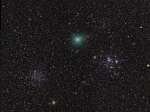 The Comet Hartley 2 Cruise
7.10.2011
Early last November, small but active Comet Hartley 2 (103/P Hartley) became the fifth comet imaged close-up by a spacecraft from planet Earth. Still cruising through the solar system with a 6 year orbital period, Hartley 2 is is making astronomical headlines again, though.
 Perihelion Approaches
15.08.2015
This dramatic outburst from the nucleus of Comet 67P/Churyumov-Gerasimenko occured on August 12, just hours before perihelion, its closest approach to the Sun. Completing an orbit of the Sun once every 6.45 years, perihelion distance for this periodic comet is about 1.3 astronomical units (AU), still outside the orbit of planet Earth (at 1 AU).
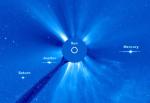 Planets In The Sun
5.05.2000
Today, all five naked-eye planets (Mercury, Venus, Mars, Jupiter, Saturn) plus the Moon and the Sun will at least approximately line-up. As viewed from planet Earth, they will be clustered within about 26 degrees, the closest alignment for all these celestial bodies since February 1962, when there was a solar eclipse!
 Equinox at Saturn
25.08.2009
What would Saturn's rings look like if the ring plane pointed directly at the Sun? That situation occurred earlier this month when equinox occurred on Saturn. Since the Earth is nearly in the same direction as the Sun from Saturn, the rings appeared to disappear from Earth.
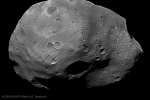 Phobos South Pole from Mars Express
24.01.2011
Where on this moon would you land? The moon pictured above is not Earth's moon but Phobos, the closest moon to the planet Mars. Phobos is so close to Mars that it is expected to break up and crash into the red planet within the next 100 million years.
 A High Energy Fleet
25.11.2000
Like a fleet of futuristic starcruisers, NASA's highly successful series of High Energy Astrophysical Observatory (HEAO) spacecraft appear poised over planet Earth. Labeled A, B, and C in this vintage illustration, the spacebased telescopes were known as HEAO-1, HEAO-2, and HEAO-3 respectively.
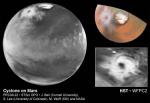 Cyclone on Mars
20.05.1999
Late last month a team of Mars-watching astronomers sighted an immense cyclonic storm system raging near the Red Planet's north pole. Their discovery picture, made with the Hubble Space Telescope on April 27, is seen at left while the projected insets (right) show closeups of the storm and surrounding areas.
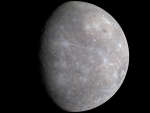 Mercury in Accentuated Color
19.03.2008
The colors of Mercury are subtle but beautiful. At first glance, our Solar System's innermost planet appears simply black and white, but images that include infrared colors normally beyond human vision accentuate a world of detail. One such image, shown above, was acquired by the robotic MESSENGER spacecraft that swung by Mercury in mid-January.
|
January February March April May June July August September October |
|||||||||||||||||||||||||||||||||||||||||||||||||