
|
You entered: Earth orbit
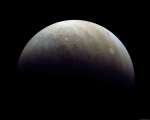 Southern Jupiter from Perijove 3
17.12.2016
Southern Jupiter looms some 37,000 kilometers away in this JunoCam image from December 11. The image data was captured near Juno's third perijove or closest approach to Jupiter, the spacecraft still in its 53 day long looping orbit.
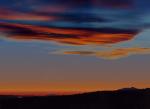 Mercury on the Horizon
20.03.2000
Have you ever seen the planet Mercury? Because Mercury orbits so close to the Sun, it is never seen far from the Sun, and so is only visible near sunrise or sunset. If trailing the Sun, Mercury will be visible for several minutes before it follows the Sun behind the Earth.
 Full Moons of August
30.08.2023
Near perigee, the closest point in its almost moonthly orbit, a Full Moon rose as the Sun set on August 1. Its brighter than average lunar disk was captured in this dramatic moonrise sequence over dense cloud banks along the eastern horizon from Ragusa, Sicily.
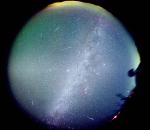 A Sky Filled with Leonids
5.12.2001
In the early morning hours of November 19, amateur Chen Huang-Ming caught a sky filled with astronomical wonders. With his fisheye camera set up on Ho-Huan Mountain in Taiwan for a half-hour exposure, he started the above image a local time of 2:33 am.
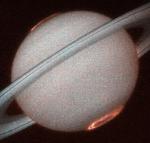 Saturnian Aurora
23.01.1999
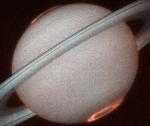
Girdling the second largest planet in the Solar System, Saturn's Rings are one of the most spectacular sights for earthbound telescopes. This image from the orbiting Hubble Space Telescope's STIS instrument, offers a striking view of another kind of ring around Saturn - pole encircling rings of ultraviolet aurora.
 Saturnian Aurora
23.12.2001
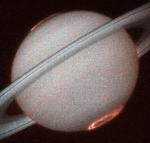
the second largest planet in the Solar System, Saturn's Rings are one of the most spectacular sights for earthbound telescopes. This image from the orbiting Hubble Space Telescope's STIS instrument, offers a striking view of another kind of ring around Saturn - pole encircling rings of ultraviolet aurora.
 Saturnian Aurora
9.01.1998
Girdling the second largest planet in the Solar System, Saturn's Rings are one of the most spectacular sights for earthbound telescopes. This recently released image, from the orbiting Hubble Space Telescope's STIS instrument, offers a striking view of another kind of ring around Saturn - pole encircling rings of ultraviolet aurora.
 APOD: 2023 August 21 Б Introducing Comet Nishimura
21.08.2023
Will Comet Nishimura become visible to the unaided eye? Given the unpredictability of comets, no one can say for sure, but it currently seems like a good bet. The comet was discovered only ten days ago by Hideo Nishimura during 30-second exposures with a standard digital camera.
 Saturnian Aurora
17.09.2000
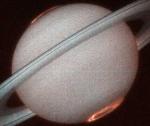
Girdling the second largest planet in the Solar System, Saturn's Rings are one of the most spectacular sights for earthbound telescopes. This image from the orbiting Hubble Space Telescope's STIS instrument, offers a striking view of another kind of ring around Saturn - pole encircling rings of ultraviolet aurora.
 Cassini Spacecraft Crosses Saturns Ring Plane
4.05.2005
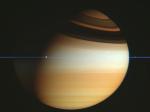
If this is Saturn, where are the rings? When Saturn's "appendages" disappeared in 1612, Galileo did not understand why. Later that century, it became understood that Saturn's unusual protrusions were rings and that when the Earth crosses the ring plane, the edge-on rings will appear to disappear.
|
January February March April May June July August September October |
|||||||||||||||||||||||||||||||||||||||||||||||||