
|
You entered: Milky Way
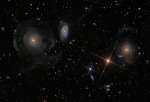 Shell Galaxies in Pisces
26.02.2011
This colorful cosmic skyscape features a peculiar system of galaxies cataloged as Arp 227 some 100 million light-years distant. Swimming within the boundaries of the constellation Pisces, Arp 227 consists of the two galaxies prominent on the left; the curious shell galaxy NGC 474 and its blue, spiral-armed neighbor NGC 470.
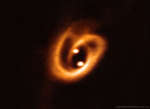 BHB2007: A Baby Binary Star in Formation
16.10.2019
How do binary stars form? To help find out, ESO's Atacama Large Millimeter Array (ALMA) recently captured one of the highest resolution images yet taken of a binary star system in formation. Most...
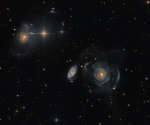 Shell Galaxies in Pisces
27.08.2020
This intergalactic skyscape features a peculiar system of galaxies cataloged as Arp 227 some 100 million light-years distant. Swimming within the boundaries of the constellation Pisces, Arp 227 consists of the two galaxies prominent right of center, the curious shell galaxy NGC 474 and its blue, spiral-armed neighbor NGC 470.
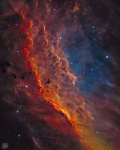 NGC 1499: The California Nebula
10.03.2021
Could Queen Calafia's mythical island exist in space? Perhaps not, but by chance the outline of this molecular space cloud echoes the outline of the state of California, USA. Our Sun has its home within the Milky Way's Orion Arm, only about 1,000 light-years from the California Nebula.
 A Deep Sky Behind an Eclipsed Moon
24.05.2022
The plan was to capture a picturesque part of the sky that was hosting an unusual guest. The result included a bonus Б an additional and unexpected guest. The beautiful background features part...
 M15: Dense Globular Star Cluster
15.06.2023
Messier 15 is an immense swarm of over 100,000 stars. A 13 billion year old relic of the early formative years of our galaxy it's one of about 170 globular star clusters that still roam the halo of the Milky Way.
 Planetary Nebula Abell 7
7.03.2025
Very faint planetary nebula Abell 7 is about 1,800 light-years distant. It lies just south of Orion in planet Earth's skies toward the constellation Lepus, The Hare. Surrounded by Milky Way stars...
 APOD: 2025 June 2 Б Veil Nebula: Wisps of an Ancient Supernova
2.06.2025
Wisps like this are all that remain visible of a Milky Way star. About 7,000 years ago that star exploded in a supernova, leaving the Veil Nebula. At the time, the expanding cloud was likely as bright as a crescent Moon, remaining visible for weeks to people living at the dawn of recorded history.
 Light Echoes from V838 Mon
27.11.2005
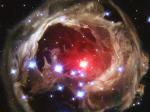
What caused this outburst of V838 Mon? For reasons unknown, star V838 Mon's outer surface suddenly greatly expanded with the result that it became the brightest star in the entire Milky Way Galaxy in January 2002. Then, just as suddenly, it faded.
 The Swarm
29.07.2006
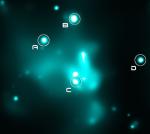
What do you call a group of black holes ... a flock, a brace, a swarm? Monitoring a region around the center of our Galaxy, astronomers have indeed found evidence for a surprisingly large number...
|
January February March April May June July August September October |
|||||||||||||||||||||||||||||||||||||||||||||||||