
|
You entered: Sun
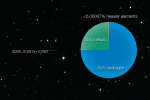 J102815: A Star That Should Not Exist
7.09.2011
Why does this star have so few heavy elements? Stars born in the generation of our Sun have an expected abundance of elements heavier than hydrogen and helium mixed into their atmospheres. Stars born...
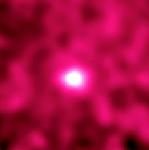 The Gamma Ray Moon
10.02.1997
What if you could see gamma rays (photons with more than 40 million times the energy of visible light)? If you could, the Moon would appear brighter than the Sun! This startling notion...
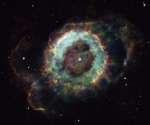 NGC 6369: The Little Ghost Nebula
14.01.2012
This pretty planetary nebula, cataloged as NGC 6369, was discovered by 18th century astronomer William Herschel as he used a telescope to explore the medicinal constellation Ophiucus. Round and planet-shaped, the nebula is also relatively faint and has acquired the popular moniker of Little Ghost Nebula.
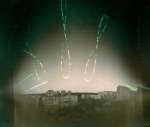 Solargraphy Analemmas
20.03.2014
Today is the equinox. The Sun crosses the celestial equator heading north at 16:57 UT, marking the northern hemisphere's first day of spring. To celebrate, consider this remarkable image following the Sun's yearly trek through planet Earth's sky, the first analemmas exposed every day through the technique of solargraphy.
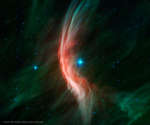 Zeta Oph: Runaway Star
8.04.2017
Like a ship plowing through cosmic seas, runaway star Zeta Ophiuchi produces the arcing interstellar bow wave or bow shock seen in this stunning infrared portrait. In the false-color view, bluish Zeta...
 Cat s Eye Hubble Remix
22.03.2008
Staring across interstellar space, the alluring Cat's Eye Nebula lies three thousand light-years from Earth. One of the most famous planetary nebulae in the sky, the Cat's Eye (NGC 6543) is over half a light-year across and represents a final, brief yet glorious phase in the life of a sun-like star.
 NGC 6164: A Dragon s Egg
24.04.2025
Beautiful emission nebula NGC 6164 was created by a rare, hot, luminous O-type star, some 40 times as massive as the Sun. Seen at the center of the cosmic cloud, the star is a mere 3 to 4 million years old.
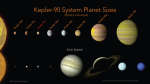 The Kepler 90 Planetary System
18.12.2017
Do other stars have planetary systems like our own? Yes -- one such system is Kepler-90. Cataloged by the orbiting Kepler satellite, an eighth planet has now been discovered giving Kepler-90 the same number of known planets as our Solar System.
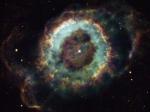 NGC 6369: The Little Ghost Nebula
7.02.2004
This pretty planetary nebula, cataloged as NGC 6369, was discovered by 18th century astronomer William Herschel as he used a telescope to explore the medicinal constellation Ophiucus. Round and planet-shaped, the nebula is also relatively faint and has acquired the popular moniker of Little Ghost Nebula.
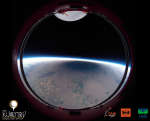 Total Solar Eclipse Shadow from a Balloon
27.08.2018
Where were you during the Great American Eclipse of 2017? A year ago last week, over 100 million of people in North America went outside to see a partial eclipse of the Sun, while...
|
January February March April May June July August September October |
|||||||||||||||||||||||||||||||||||||||||||||||||