
|
You entered: nebula
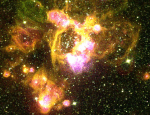 Superbubbles in the LMC
3.07.1996
Why is there a hole in the center of this nebula? A leading explanation is that it is caused by the stellar winds from the stars that live there. Stars - including the Sun - expel electrons, protons, and other charged ions in a steady stream - the stellar wind.
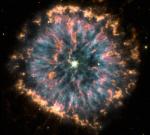 Celebrating Hubble With NGC 6751
7.04.2000
Planetary nebulae do look simple, round, and planet-like in small telescopes. But images from the orbiting Hubble Space Telescope have become well known for showing these fluorescent gas shrouds of dying Sun-like stars to possess a staggering variety of detailed symmetries and shapes.
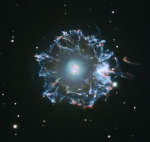 Halo of the Cat s Eye
20.10.2018
Not a Falcon 9 rocket launch after sunset, the Cat's Eye Nebula (NGC 6543) is one of the best known planetary nebulae in the sky. Its haunting symmetries are seen in the very...
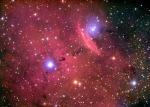 Emission and Reflection in NGC 6559
23.10.2001
Bright gas and dark dust permeate the space between stars in a nebula known as NGC 6559. The gas, primarily hydrogen, is responsible for the diffuse red glow of the emission nebula. As energetic...
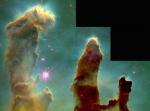 M16: Stars from Eagle's EGGs
25.11.2001
Newborn stars are forming in the Eagle Nebula. This image, taken with the Hubble Space Telescope in 1995, shows evaporating gaseous globules (EGGs) emerging from pillars of molecular hydrogen gas and dust. The giant pillars are light years in length and are so dense that interior gas contracts gravitationally to form stars.
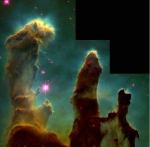 M16: Stars from Eagle's Eggs
24.09.2000
Newborn stars are forming in the Eagle Nebula. This image, taken with the Hubble Space Telescope in 1995, shows evaporating gaseous globules (EGGs) emerging from pillars of molecular hydrogen gas and dust. The giant pillars are light years in length and are so dense that
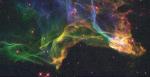 The Cygnus Loop
25.07.1999
The shockwave from a 20,000 year-old supernova in the constellation of Cygnus supernova explosion is still expanding into interstellar space. The collision of this fast moving wall of gas with a stationary cloud...
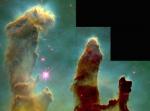 M16: Stars from Eagles EGGs
26.10.2003
Newborn stars are forming in the Eagle Nebula. This image, taken with the Hubble Space Telescope in 1995, shows evaporating gaseous globules (EGGs) emerging from pillars of molecular hydrogen gas and dust. The giant pillars are light years in length and are so dense that interior gas contracts gravitationally to form stars.
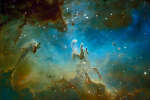 The Pillars of Eagle Castle
10.07.2009
What lights up this castle of star formation? The familiar Eagle Nebula glows bright in many colors at once. The above image is a composite of three of these glowing gas colors. Pillars of dark dust nicely outline some of the denser towers of star formation.
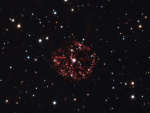 GK Per: Nova of 1901
5.11.2011
Early in the 20th century, GK Persei briefly became one of the brightest stars in planet Earth's sky, an event known as Nova Persei 1901. Documented in this modern day composite of two images from 2003 and 2011 the ejecta from the explosion, popularly called the Firework Nebula, continues to expand into space.
|
January February March April May June July August |
||||||||||||||||||||||||||||||||||||||||||||||||||||||||