
|
You entered: ring
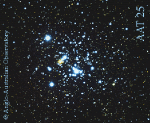 NGC 4755: A Jewel Box of Stars
11.11.1996
The great variety of star colors in this open cluster underlie it's name: The Jewel Box. The bright central star Kappa Crucis is red, in contrast to the many blue stars that surround it. The cluster contains just over 100 stars, and might be no older than 10 million years.
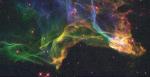 The Cygnus Loop
25.07.1999
The shockwave from a 20,000 year-old supernova in the constellation of Cygnus supernova explosion is still expanding into interstellar space. The collision of this fast moving wall of gas with a stationary cloud...
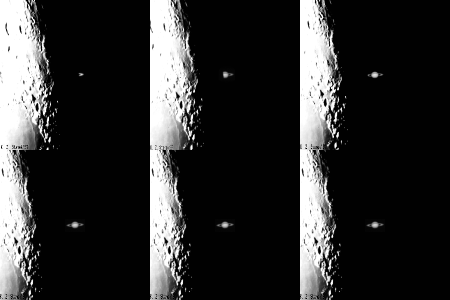 Moon Occults Saturn
24.09.1997
Many stargazers in the U. S. were able to watch a lovely lunar occultation early last Thursday morning as a bright Moon passed in front of Saturn. Using a 1.2 meter reflector, astronomer Kris Stanek had an excellent view of this dream-like event from the Whipple Observatory atop Arizona's Mount Hopkins.
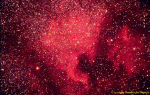 The North America Nebula
6.06.1996
Here's a familiar shape in an unfamiliar location! This emission nebula is famous partly because it resembles Earth's North American Continent. To the right of the North America Nebula is a less luminous Pelican Nebula. Let's be grateful that pelicans aren't really that large!
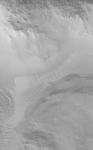 Mars in the New Year
6.01.2000
Many will long remember where they were and what they were doing when the calendar rolled over to the year 2000. On Mars, of course, that date was nothing special and the Mars Global Surveyor spacecraft continued with business as usual - systematically recording images of the Red Planet from orbit.
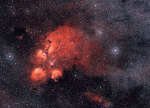 Wide Angle: The Cats Paw Nebula
21.04.2010
Nebulae are perhaps as famous for being identified with familiar shapes as perhaps cats are for getting into trouble. Still, no known cat could have created the vast Cat's Paw Nebula visible in Scorpius.
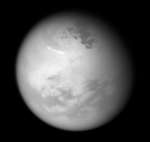 Northern Summer on Titan
22.06.2017
While yesterday's solstice brought summer to planet Earth's northern hemisphere, a northern summer solstice arrived for ringed planet Saturn nearly a month ago on May 24. Following the Saturnian seasons, its large moon Titan was captured in this Cassini spacecraft image from June 9.
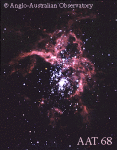 The Violent Star Cluster 30 Doradus
23.05.1996
The largest, most violent star forming region known in the whole Local Group of galaxies lies in our neighboring galaxy the LMC. Were 30 Doradus at the distance of the Orion Nebula -- a local star forming region -- it would take up fully half the sky.
 The Belt of Venus
9.12.2001
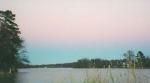
Although you've surely seen it, you might not have noticed it. During a cloudless twilight, just before sunrise or after sunset, part of the atmosphere above the horizon appears slightly off-color, slightly pink.
 A Galaxy Gravitational Lens
20.12.1995
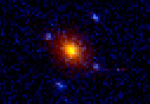
Sometimes it takes a keen eye to see a good mirage. Around the center of the red galaxy image in the above photograph lie four blue "smudges." Each smudge is actually a different image of the same background quasar. The central galaxy happens to fall directly in the light path of the quasar.
|
January February March April May June July August September October |
|||||||||||||||||||||||||||||||||||||||||||||||||