
|
You entered: Jupiter
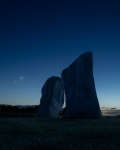 APOD: 2026 June 12 Б Venus and Jupiter: Conjunction from Avebury
12.06.2026
To see Venus and Jupiter together this month, you won't need binoculars or even a telescope. Just look up after sunset and you'll find them emerging as the sky grows dark near the western horizon.
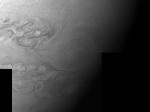 New Horizons Spacecraft Passes Jupiter
7.03.2007
A new spacecraft is headed for the outer Solar System. Named New Horizons, this robotic explorer passed Jupiter last week after being launched only in early 2006. New Horizons is being pulled by Jupiter's gravity to a greater speed toward its next target: Pluto in 2015.
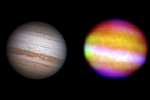 Jupiter from the Stratosphere
3.06.2010
SOFIA, the Stratospheric Observatory for Infrared Astronomy, captured its "first light" images on May 26, from an altitude of 35,000 feet. While flying above most of planet Earth's infrared-absorbing water vapor, SOFIA's premier infrared views of the cosmos included this remarkable false-color image (right panel) of Jupiter.
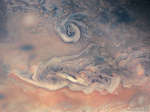 Swirls and Colors on Jupiter from Juno
21.11.2018
What creates the colors in Jupiter's clouds? No one is sure. The thick atmosphere of Jupiter is mostly hydrogen and helium, elements which are colorless at the low temperatures of the Jovian cloud tops.
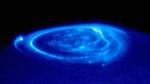 A Close Up of Aurora on Jupiter
19.12.2000
Jupiter has aurorae. Like Earth, the magnetic field of the gas giant funnels charged particles released from the Sun onto the poles. As these particles strike the atmosphere, electrons are temporarily knocked away from existing gas molecules. Electric force attracts these electrons back. As the electrons recombine to remake neutral molecules, auroral light is emitted.
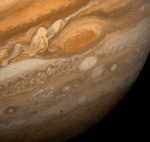 The Clouds of Jupiter
20.09.1997
What makes the colors in Jupiter's clouds? With a mean temperature of 120 degrees Kelvin (-153 degrees Celsius) and a composition dominated by hydrogen (about 90%), and helium (about 10%) with a smattering...
 Jupiter s Clouds from New Horizons
15.10.2007
The New Horizons spacecraft took some stunning images of Jupiter earlier this year while on the way out to Pluto. Famous for its Great Red Spot, Jupiter is also known for its regular, equatorial cloud bands, visible through even modest sized telescopes.
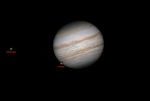 Jupiter Rotates as Moons Orbit
25.10.2022
Jupiter and its moons move like our Sun and its planets. Similarly, Jupiter spins while its moons circle around. JupiterБs rotation can be observed by tracking circulating dark belts and light zones. The Great Red Spot, the largest storm known, rotates to become visible after about 15 seconds in the 48-second time lapse video.
 Stereo Jupiter near Opposition
5.12.2024
Jupiter looks sharp in these two rooftop telescope images. Both were captured last year on November 17 from Singapore, planet Earth, about two weeks after Jupiter's 2023 opposition. Climbing high in midnight skies the giant planet was a mere 33.4 light-minutes from Singapore. That's about 4 astronomical units away.
 Jupiter and Saturn Great Conjunction: The Movie
30.12.2020
Yes, but have you seen a movie of Jupiter and Saturn's Great Conjunction? The featured time-lapse video was composed from a series of images taken from Thailand and shows the two giant planets as they angularly passed about a tenth of a degree from each other.
|
January February March April May June July August September October |
|||||||||||||||||||||||||||||||||||||||||||||||||