
|
You entered: Orion Nebula
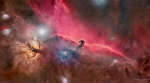 The Horsehead Nebula Region without Stars
29.08.2022
The famous Horsehead Nebula in Orion is not alone. A deep exposure shows that the dark familiar shaped indentation, visible just right of center, is part of a vast complex of absorbing dust and glowing gas.
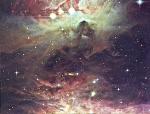 Reflections Of Orion
15.01.1999
The Orion Nebula and its surroundings present skygazers with a wondrous jumble of newborn stars, gas, and dust. Emission nebulae - glowing energized clouds of gas, and reflection nebulae - dust clouds shining by reflected starlight, abound at this photogenic cosmic location a mere 1,500 light-years or so away.
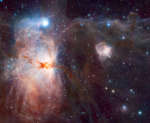 The Flame Nebula in Infrared
12.01.2010
What lights up the Flame Nebula? Fifteen hundred light years away towards the constellation of Orion lies a nebula which, from its glow and dark dust lanes, appears, on the left, like a billowing fire. But fire, the rapid acquisition of oxygen, is not what makes this Flame glow.
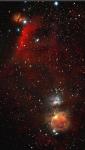 Orion Nebulosities
30.05.2002
Adrift 1,500 light-years away in one of the night sky's most recognizable constellations, the glowing Orion Nebula and the dark Horsehead Nebula are contrasting cosmic vistas. They both appear in this stunning composite color photograph along with other nebulosities as part of the giant Orion Molecular Cloud complex, itself hundreds of light-years across.
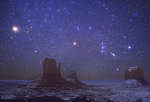 Mars and Orion Over Monument Valley
25.12.2007
Welcome to The World At Night. Sharing the night sky seen around the world, this view from Monument Valley, USA includes a picturesque foreground of famous buttes. Buttes are composed of hard volcanic rock left behind after water eroded away the surrounding soft rock.
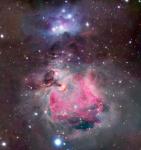 Colorful Clouds of Orion
20.12.2002
Revisiting one of the most famous nebulae in planet Earth's night sky, astrophotographer Robert Gendler has constructed this stunning, color-enhanced mosiac of the region surrounding the Great Nebula in Orion. As seen here...
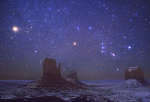 Mars and Orion over Monument Valley
2.02.2014
Welcome to The World At Night. Sharing the night sky seen around the world, this view from Monument Valley, USA includes a picturesque foreground of famous buttes. Buttes are composed of hard rock left behind after water eroded away the surrounding soft rock.
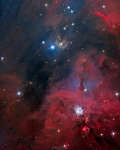 South of Orion
27.01.2022
South of the large star-forming region known as the Orion Nebula, lies bright blue reflection nebula NGC 1999. At the edge of the Orion molecular cloud complex some 1,500 light-years distant, NGC 1999's illumination is provided by the embedded variable star V380 Orionis.
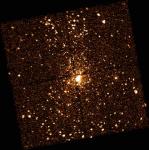 X-Ray Stars Of Orion
4.02.2000
The stars of Orion shine brightly in northern winter skies where the constellation harbors the closest large stellar nursery, the Great Nebula of Orion, a mere 1500 light-years away. In fact, the apparently bright...
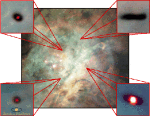 Planetary Systems Now Forming in Orion
7.12.1996
How do planets form? Astronomers are finding out by studying one of the most interesting of all astronomical nebulae known, the Great Nebula in Orion. Insets to above mosaic show several planetary systems in formation. The bottom left insert shows the relative size of our own Solar System. The Orion Nebula contains many stellar nurseries.
|
January February March April May June July August September October |
|||||||||||||||||||||||||||||||||||||||||||||||||