
|
You entered: Ring Nebula
 APOD: 2024 February 14 Б Rosette Deep Field
14.02.2024
Can you find the Rosette Nebula? The large, red, and flowery-looking nebula on the upper left may seem the obvious choice, but that is actually just diffuse hydrogen emission surrounding the Cone and Fox Fur Nebulas.
 A Window to the Once Secret Sky
13.04.2005
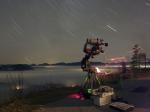
If there was a window nearby to the distant universe -- would you look through it? Quite possibly, there is, in the form of a small telescope. A local skykeeper could be a relative or a stranger and is frequently proud to show off the sky free of charge.
 APOD: 2026 August 3 Б Vaporizing Meteor Photobombs the Lacerta Nebula
3.08.2026
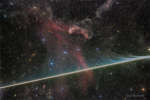
What's happening to this meteor? This bright meteor streak appeared and disappeared quickly during a long exposure of the Great Lacerta Nebula, seen faintly in red toward the center of the image.
 Scorpius Enhanced
16.06.2021
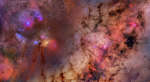
If Scorpius looked this good to the unaided eye, humans might remember it better. Scorpius more typically appears as a few bright stars in a well-known but rarely pointed out zodiacal constellation. To get a spectacular image like this, though, one needs a good camera, a dark sky, and some sophisticated image processing.
 NGC 281: Cluster, Clouds, and Globules
20.10.2004
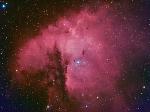
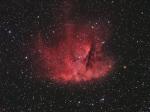
NGC 281 is a busy workshop of star formation. Prominent features include a small open cluster of stars, a diffuse red-glowing emission nebula, large lanes of obscuring gas and dust, and dense knots of dust and gas in which stars may still be forming.
 NGC 281: The Pacman Nebula
23.08.2005
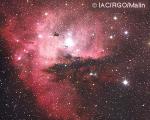
NGC 281 is a busy workshop of star formation. Prominent features include a small open cluster of stars, a diffuse red-glowing emission nebula, large lanes of obscuring gas and dust, and dense knots of dust and gas in which stars may still be forming.
 NGC 281: Cluster, Clouds, and Globules
21.09.1998
NGC 281 is a busy workshop of star formation. Prominent features include a small open cluster of stars, a diffuse red-glowing emission nebula, large lanes of obscuring gas and dust, and dense knots of dust and gas in which stars may still be forming.
 Shapley 1: An Annular Planetary Nebula
12.12.1995
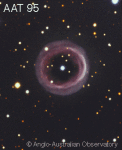
This strange structure is what can result when a normal star runs out of nuclear fuel in its core. At that time, the center condenses into a white dwarf while the outer atmospheric layers are expelled into space and appear as a planetary nebula.
 NGC 281: Cluster, Clouds, and Globules
7.04.2003
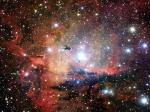
NGC 281 is a busy workshop of star formation. Prominent features include a small open cluster of stars, a diffuse red-glowing emission nebula, large lanes of obscuring gas and dust, and dense knots of dust and gas in which stars may still be forming.
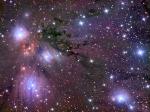 Stars, Dust and Nebula in NGC 2170
28.02.2007
When stars form, pandemonium reigns. A textbook case is the star forming region NGC 2170. Visible above are red glowing emission nebulas of hydrogen, blue reflection nebulas of dust, dark absorption nebulas of dust, and the stars that formed from them.
|
January February March April May June July August September October |
|||||||||||||||||||||||||||||||||||||||||||||||||