
|
You entered: Sagittarius
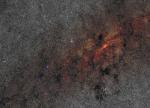 The Galactic Center in Infrared
16.07.2006
The center of our Galaxy is a busy place. In visible light, much of the Galactic Center is obscured by opaque dust. In infrared light, however, dust glows more and obscures less, allowing nearly one million stars to be recorded in the above photograph.
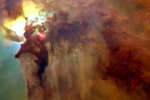 In the Center of the Lagoon Nebula
19.10.2008
The center of the Lagoon Nebula is a whirlwind of spectacular star formation. Visible on the upper left, at least two long funnel-shaped clouds, each roughly half a light-year long, have been formed by extreme stellar winds and intense energetic starlight. The tremendously bright nearby star, Hershel 36, lights the area.
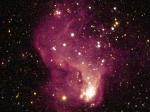 Star Forming Region Hubble V
25.12.2001
How did stars form in the early universe? Astronomers are gaining insight by studying NGC 6822, a nearby galaxy classified as irregular by modern standards but appearing more typical of galaxies billions of years ago. Inspection of NGC 6822 shows several bright star groups, including two dubbed Hubble-X and Hubble-V.
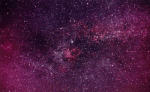 The Milky Way Near the Northern Cross
15.05.1996
This beautiful image of the sky near the bright star Deneb (just above center) reveals the stars, nebulae, and dark clouds along the plane of our Milky Way Galaxy as seen from the northern hemisphere (near Columbia Missouri, USA). Just below Deneb lies the suggestively shaped North American emission nebula.
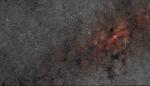 The Galactic Center in Infrared
21.06.1999
The center of our Galaxy is a busy place. In visible light, much of the Galactic Center is obscured by opaque dust. In infrared light, however, dust glows more and obscures less, allowing nearly one million stars to be recorded in the above photograph.
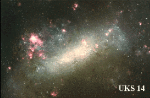 The Large Cloud of Magellan (LMC)
23.10.1996
Magellan and his crew had plenty of time to study the southern sky during their famous voyage around the world. As a result, two fuzzy cloud like objects in the southern sky are now known as the Clouds of Magellan. These star clouds are small irregular galaxies, satellites of our larger Milky Way spiral galaxy.
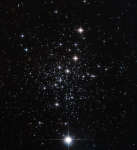 Palomar 12
18.02.2015
Palomar 12 was not born here. The stars of the globular cluster, first identified in the Palomar Sky Survey, are younger than those in other globular star clusters that roam the halo of our Milky Way Galaxy.
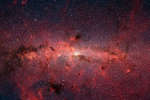 Stars at the Galactic Center
14.06.2009
The center of our Milky Way Galaxy is hidden from the prying eyes of optical telescopes by clouds of obscuring dust and gas. But in this stunning vista, the Spitzer Space Telescope's infrared cameras, penetrate much of the dust revealing the stars of the crowded galactic center region.
 Star Factory Messier 17
18.04.2013
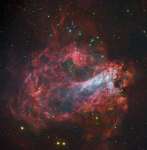
Sculpted by stellar winds and radiation, the star factory known as Messier 17 lies some 5,500 light-years away in the nebula-rich constellation Sagittarius. At that distance, this degree wide field of view spans almost 100 light-years.
 In the Center of the Omega Nebula
8.02.2004
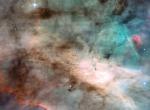
In the depths of the dark clouds of dust and molecular gas known as the Omega Nebula, stars continue to form. The above image from the Hubble Space Telescope's Advanced Camera for Surveys shows exquisite detail in the famous star-forming region.
|
January February March April May June July August September October |
|||||||||||||||||||||||||||||||||||||||||||||||||