
|
You entered: active Sun
 APOD: 2024 July 28 Б Sun Dance
28.07.2024
Sometimes, the surface of our Sun seems to dance. In the middle of 2012, for example, NASA's Sun-orbiting Solar Dynamic Observatory spacecraft imaged an impressive prominence that seemed to perform a running dive roll like an acrobatic dancer.
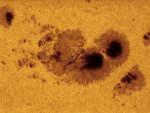 AR1520: Islands in the Photosphere
14.07.2012
Awash in a sea of plasma and anchored in magnetic fields, sunspots are planet-sized, dark islands in the solar photosphere, the bright surface of the Sun. Dark because they are slightly cooler than the surrounding surface, this group of sunspots is captured in a close-up telescopic snapshot from July 11.
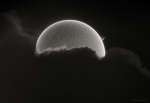 Half Sun with Prominence
2.11.2020
What's happening to the Sun? Clearly, the Sun's lower half is hidden behind a thick cloud. Averaging over the entire Earth, clouds block the Sun about 2/3rds of the time, although much less over many land locations. On the Sun's upper right is a prominence of magnetically levitating hot gas.
 A Sudden Jet on Comet 67P?
18.11.2015
There she blows! A dramatic demonstration of how short-lived some comet jets can be was documented in late July by the robotic Rosetta spacecraft orbiting the nucleus of Comet 67P/Churyumov-Gerasimenko. The featured animation depicts changes in the rotating comet with three illuminating stills.
 APOD: 2024 May 20 Б Aurora Dome Sky
20.05.2024
It seemed like night, but part of the sky glowed purple. It was the now famous night of May 10, 2024, when people over much of the world reported beautiful aurora-filled skies. The featured image was captured this night during early morning hours from Arlington, Wisconsin, USA.
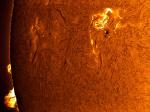 Sunspot 875 Flares
2.05.2006
An unusually active sunspot region is now crossing the Sun. The region, numbered 875, is larger than the Earth and has produced several solar flares over the past week. It should take a few more days for Sunspot 875 to finish crossing the solar disk.
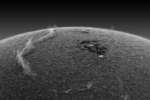 A Filament Across the Sun
20.08.2012
Is that a cloud hovering over the Sun? Yes, but it is quite different than a cloud hovering over the Earth. The long light feature on the left of the above color-inverted image is actually a solar filament and is composed of mostly charged hydrogen gas held aloft by the Sun's looping magnetic field.
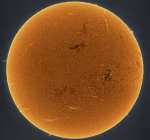 Orange Sun Scintillating
15.11.2011
Our Sun is becoming a busy place. Taken just last week, the Sun was captured sporting numerous interesting features including one of the larger sunspot groups yet recorded: AR 1339 visible on the image right. Only last year, the Sun was emerging from an unusually quiet Solar Minimum that lasted for years.
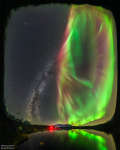 Milky Way Auroral Flower
18.10.2022
Could the stem of our Milky Way bloom into an auroral flower? No, not really, even though it may appear that way in todayБs featured all-sky image. On the left, the central plane of our home galaxy extends from the horizon past the middle of the sky.
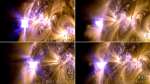 Four X-class Flares
16.05.2013
Swinging around the Sun's eastern limb on Monday, a group of sunspots labeled active region AR1748 has produced the first four X-class solar flares of 2013 in less than 48 hours. In time sequence clockwise from the top left, flashes from the four were captured in extreme ultraviolet images from the Solar Dynamics Observatory.
|
January February March April May June July August September |
|||||||||||||||||||||||||||||||||||||||||||||||||