
|
You entered: galactic cluster
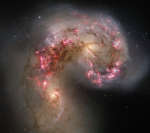 The Antennae Galaxies in Collision
18.07.2010
Two galaxies are squaring off in Corvus and here are the latest pictures. But when two galaxies collide, the stars that compose them usually do not. That's because galaxies are mostly empty space and, however bright, stars only take up only a small amount of that space.
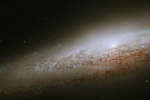 NGC 2683: Spiral Edge On
11.10.2010
Does spiral galaxy NGC 2683 have a bar across its center? Being so nearly like our own barred Milky Way Galaxy, one might guess it has. Being so nearly edge-on, however, it is hard to tell.
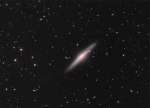 NGC 2683: Edge On Spiral Galaxy
17.03.2012
This elegant island universe is cataloged as NGC 2683. It lies a mere 16 million light-years distant toward the northern constellation Lynx. A spiral galaxy comparable to our own Milky Way, NGC 2683 is seen nearly edge-on in the cosmic vista.
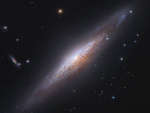 NGC 2683: Edge On Spiral Galaxy
5.02.2014
Does spiral galaxy NGC 2683 have a bar across its center? Being so nearly like our own barred Milky Way Galaxy, one might guess it has. Being so nearly edge-on, however, it is hard to tell.
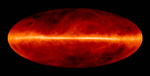 A Sky Full Of Hydrogen
18.12.1996
Interstellar space is filled with extremely tenuous clouds of gas which are mostly Hydrogen. The neutral hydrogen atom (HI in astronomer's shorthand) consists of 1 proton and 1 electron. The proton and electron spin like tops but can have only two orientations; spin axes parallel or anti-parallel.
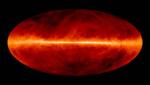 A Sky Full Of Hydrogen
1.03.1998
Interstellar space is filled with extremely tenuous clouds of gas which are mostly Hydrogen. The neutral hydrogen atom (HI in astronomer's shorthand) consists of 1 proton and 1 electron. The proton and electron spin like tops but can have only two orientations; spin axes parallel or anti-parallel.
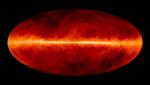 A Sky Full Of Hydrogen
13.01.2001
Interstellar space is filled with extremely tenuous clouds of gas which are mostly Hydrogen. The neutral hydrogen atom (HI in astronomer's shorthand) consists of 1 proton and 1 electron. The proton and electron spin like tops but can have only two orientations; spin axes parallel or anti-parallel.
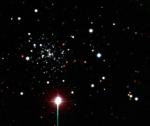 Palomar 13 s Last Stand
25.01.2003
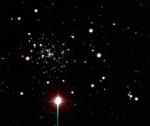
Globular star cluster Palomar 13 has roamed the halo of our Milky Way Galaxy for the last 12 billion years. The apparently sparse cluster of stars just left of center in this composite color digital image, it is one of the smallest, faintest globular clusters known.
 Palomar 13's Last Stand
30.11.2000
Globular star cluster Palomar 13 has roamed the halo of our Milky Way Galaxy for the last 12 billion years. The apparently sparse cluster of stars just left of center in this composite color digital image, it is one of the smallest, faintest globular clusters known.
 NGC 4676: When Mice Collide
31.01.2015
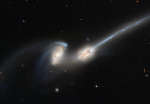
These two mighty galaxies are pulling each other apart. Known as the "Mice" because they have such long tails, each spiral galaxy has likely already passed through the other. The long tails are created by the relative difference between gravitational pulls on the near and far parts of each galaxy.
|
January February March April May June July August September October |
|||||||||||||||||||||||||||||||||||||||||||||||||