
|
You entered: infrared
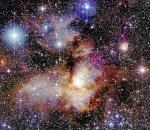 Star-Forming Region RCW38 from 2MASS
17.07.2002
The star cluster in RCW38 was hiding. Looking at the star forming region RCW38 will not normally reveal most of the stars in this cluster. The reason is that the open cluster is so young that it is still shrouded in thick dust that absorbs visible light.
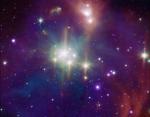 Coronet in the Southern Crown
21.09.2007
X-rays from young stars and infrared light from stars and cosmic dust are combined in this false color image of a star-forming region in Corona Australis, the Southern Crown. The small star grouping is fittingly known as the Coronet Cluster.
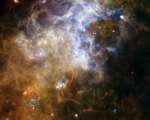 Herschel Views the Milky Way
16.10.2009
With a 3.5 meter diameter mirror, larger than the Hubble Space Telescope, Herschel is ESA's new infrared observatory. The space-based telescope is named for German-born British astronomer Frederick William Herschel who discovered infrared light over 200 years ago.
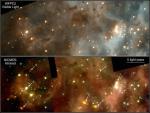 New Stars In 30 Doradus
1.10.1999
Compare these matched Hubble Space Telescope views (visible-light on top; infrared on bottom) of a region in the star-forming 30 Doradus Nebula. Find the numbered arrows in the infrared image which identify newborn massive stars. For example, arrows 1 and 5 both point to compact clusters of bright young stars.
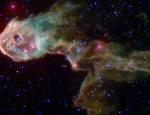 Inside The Elephant's Trunk
9.04.2005
In December of 2003, the world saw spectacular first images from the Spitzer Space Telescope, including this penetrating interior view of an otherwise opaque dark globule known as the Elephant's Trunk Nebula. Seen...
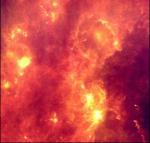 IRAS Orion
31.07.1998
Do you recognize the constellation Orion? This striking but unfamiliar looking picture of the familiar Orion region of the sky was produced using survey data from the InfraRed Astronomical Satellite (IRAS). It combines information...
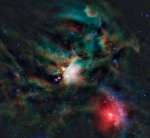 Young Stars in the Rho Ophiuchi Cloud
14.04.2011
Dust clouds and embedded newborn stars glow at infrared wavelengths in this tantalizing false-color composition from WISE, the Wide-field Infrared Survey Explorer. The cosmic canvas features one of the closest star forming regions, part of the Rho Ophiuchi cloud complex some 400 light-years distant near the southern edge of the pronounceable constellation Ophiuchus.
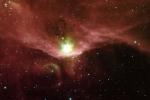 Sharpless 140
20.05.2004
Three young, massive stars will eventually emerge from this natal cloud of dust and gas, but their presence is already revealed in this false-color image from the Spitzer Space Telescope. The picture offers...
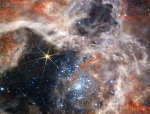 Tarantula Stars R136 from Webb
7.09.2022
Near the center of a nearby star-forming region lies a massive cluster containing some of the largest and hottest stars known. Collectively known as star cluster NGC 2070, these stars are part of the vast Tarantula Nebula and were captured in two kinds of infrared light by the new Webb Space Telescope.
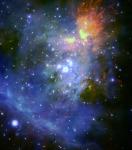 The Orion Nebula from Subaru
2.02.1999
The Orion Nebula (M42) shows a host of treasures when viewed in infrared light. Some stars in the Trapezium, an open cluster of stars at the center, are only visible in infrared light. The orange feature above center is called the Kleinman-Low Nebula, and appears greatly affected by newly forming central star IRc2.
|
January February March April May June July August September October |
|||||||||||||||||||||||||||||||||||||||||||||||||