
|
You entered: interstellar dust
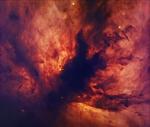 Flame Nebula Close Up
2.02.2007
Of course, the Flame Nebula is not on fire. Also known as NGC 2024, the nebula's suggestive reddish color is due to the glow of hydrogen atoms at the edge of the giant Orion molecular cloud complex some 1,500 light-years away.
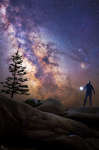 Behold the Universe
3.08.2016
What if you climbed up on a rock and discovered the Universe? You can. Although others have noted much of it before, you can locate for yourself stars, planets, and even the plane of our Milky Way Galaxy. All you need is a dark clear sky -- the rock is optional.
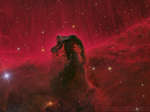 The Horsehead Nebula
17.12.2019
Sculpted by stellar winds and radiation, a magnificent interstellar dust cloud by chance has assumed this recognizable shape. Fittingly named the Horsehead Nebula, it is some 1,500 light-years distant, embedded in the vast Orion cloud complex.
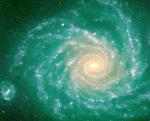 Spiral Galaxy NGC 1232
22.05.2001
Galaxies are fascinating not only for what is visible, but for what is invisible. Grand spiral galaxy NGC 1232, captured in detail by one of the new Very Large Telescopes, is a good example.
 NGC 1893 and the Tadpoles of IC 410
2.02.2024
This cosmic view shows off an otherwise faint emission nebula IC 410, captured under clear Netherlands skies with telescope and narrowband filters. Above and right of center you can spot two remarkable inhabitants of the interstellar pond of gas and dust, known as the tadpoles of IC 410.
 The Deep Lagoon
28.09.2023
Ridges of glowing interstellar gas and dark dust clouds inhabit the turbulent, cosmic depths of the Lagoon Nebula. Also known as M8, The bright star forming region is about 5,000 light-years distant. It makes for a popular stop on telescopic tours of the constellation Sagittarius toward the center of our Milky Way Galaxy.
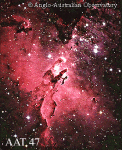 M16: Nebula With Star Cluster
18.01.1997
The photogenic M16 shown above is composed of a young star cluster associated with a spectacular emission nebulae lined with clouds of interstellar dust. The gorgeous spectacle lies toward the galactic center region, some 7,000 light years distant in the constellation Serpens.
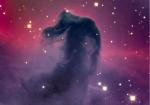 The Dark Horsehead Nebula
29.12.2000
While drifting through the cosmos, sculpted by stellar winds and radiation, this magnificent interstellar dust cloud has chanced to assume a recognizable shape. Fittingly named The Horsehead Nebula it is embedded in the immense complex of star forming gas and dust surrounding the Orion Nebula some 1,500 light-years distant.
 The Milky Way in Infrared
30.01.2000
At night, from a dark location, part of the clear sky looks milky. This unusual swath of dim light is generally visible during any month and from any location. Until the invention of the telescope, nobody really knew what the "Milky Way" was.
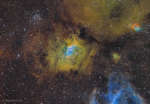 NGC 7635: Bubble in a Cosmic Sea
23.11.2016
Do you see the bubble in the center? Seemingly adrift in a cosmic sea of stars and glowing gas, the delicate, floating apparition in this widefield view is cataloged as NGC 7635 - The Bubble Nebula.
|
January February March April May June July August September |
|||||||||||||||||||||||||||||||||||||||||||||||||