
|
You entered: ring galaxy
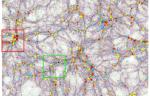 Finding Dark Matter
19.12.2001
Where is dark matter? Galaxies rotate and move in clusters as if a tremendous amount of unseen matter is present. But does dark matter exist in the greater universe too -- and if so, where? The answer can be found by comparing the distribution of galaxies observed with numerical simulations.
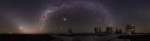 Wonder and Mystery above the Very Large Telescopes
9.05.2011
What's that bright orange dot above the large telescope on the right? Even seasoned sky enthusiasts might ponder the origin of the orange orb seen by scrolling across this panoramic image, taken last December. Perhaps identifying known objects will help.
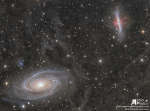 Galaxy Wars: M81 versus M82
3.02.2016
In the lower left corner, surrounded by blue spiral arms, is spiral galaxy M81. In the upper right corner, marked by red gas and dust clouds, is irregular galaxy M82. This stunning vista shows these two mammoth galaxies locked in gravitational combat, as they have been for the past billion years.
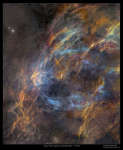 Cygnus Shell Supernova Remnant W63
2.11.2018
The ghost of a long-dead star, the W63 supernova remnant shines like a faint cosmic smoke-ring along the plane of the Milky Way galaxy toward the northern constellation Cygnus the swan. Its wraithlike appearance is traced against the region's rich complex of interstellar clouds and dust by an eerie blue glow.
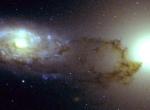 Dusting Spiral Galaxies
16.01.1998
How much dust is in spiral galaxies? Does it block out much of the starlight? Because astronomers rely on an accurate knowledge of galaxy properties to investigate a wide range of problems, like galaxy and quasar evolution and the nature of dark matter, answers to simple questions like this are key.
 Starburst Galaxy Messier 94
6.03.2025
Beautiful island universe Messier 94 lies a mere 15 million light-years distant in the northern constellation of the hunting dogs, Canes Venatici. A popular target for earth-based astronomers, the face-on spiral galaxy is about 30,000 light-years across, with spiral arms sweeping through the outskirts of its broad disk.
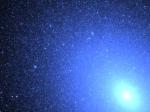 M32: Blue Stars in an Elliptical Galaxy
3.11.1999
Elliptical galaxies are known for their old, red stars. But is this old elliptical up to new tricks? In recent years, the centers of elliptical galaxies have been found to emit unexpectedly high amounts of blue and ultraviolet light.
 APOD: 2025 August 22 Б A Tale of Two Nebulae
22.08.2025
This colorful telescopic view towards the musical northern constellation Lyra reveals the faint outer halos and brighter central ring-shaped region of M57, popularly known as the Ring Nebula. To modern astronomers M57 is a well-known planetary nebula.
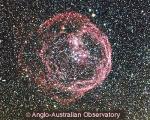 Henize 70: A SuperBubble In The LMC
13.06.1998
Stars with tens of times the mass of the Sun profoundly affect their galactic environment. Churning and mixing the interstellar gas and dust clouds they leave their mark in the compositions and locations of future generations of stars and star systems.
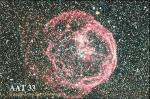 Henize 70: A SuperBubble In The LMC
10.05.1996
Massive stars (tens of times the mass of the Sun) profoundly affect their galactic environment. Churning and mixing the clouds of gas and dust between the stars, they leave their mark in the compositions and locations of future generations of stars and star systems.
|
January February March April May June July August September October |
|||||||||||||||||||||||||||||||||||||||||||||||||