
|
You entered: rocks
 APOD: 2024 August 7 Б Milky Way Behind Three Merlons
7.08.2024
To some, they look like battlements, here protecting us against the center of the Milky Way. The Three Merlons, also called the Three Peaks of Lavaredo, stand tall today because they are made of dense dolomite rock which has better resisted erosion than surrounding softer rock.
 APOD: 2026 September 12 Б Apollo 11: Catching Some Sun
12.09.2026
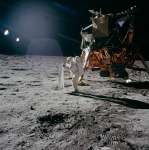
Bright sunlight glints as long dark shadows mark this image of the surface of the Moon. It was taken on July 20, 1969, by Apollo 11 astronaut Neil Armstrong, the first to walk on the lunar surface. Pictured is the mission's lunar module, the Eagle, and spacesuited lunar module pilot Buzz Aldrin.
 Io in True Color
20.09.1999
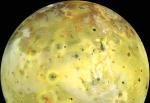
The strangest moon in the Solar System is bright yellow. This recently released picture, showing Io's true colors, was taken in July by the Galileo spacecraft currently orbiting Jupiter. Io's colors derive from sulfur and molten silicate rock. The unusual surface of Io is kept very young by its system of active volcanoes.
 The Past of Asteroid Eros
9.10.2001
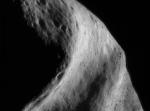
How did large rocks come to be scattered on the surface of asteroid Eros? Eros stands out not only because of its proximity to Earth but also because it was visited recently by NASA's NEAR-Shoemaker spacecraft.
 Apollo 15: Driving on the Moon
23.02.1996
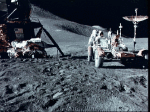
Apollo 15 astronaut James Irwin works on the first Lunar Roving Vehicle, before he and fellow astronaut David Scott take it out for a drive. Sloping up behind the lunar module "Falcon" on the left are lunar mountains Hadley Delta and Apennine Front, while about 5 kilometers behind Irwin is St. George Crater.
 Layered Hills in Arabia Terra on Mars
15.08.2010
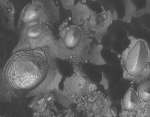
Why are some hills on Mars so layered? The answer is still under investigation. Clearly, dark windblown sand surrounds outcropping of light sedimentary rock across the floor of crater Arabia Terra. The light rock clearly appears structured into many layers, the lowest of which is likely very old.
 Apollo 15: Driving on the Moon
7.06.1997
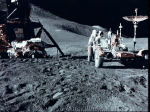
Apollo 15 astronaut James Irwin works on the first Lunar Roving Vehicle, before he and fellow astronaut David Scott take it out for a drive. Sloping up behind the lunar module "Falcon" on the left are lunar mountains Hadley Delta and Apennine Front, while about 5 kilometers behind Irwin is St. George Crater.
 Io in True Color
3.10.2010
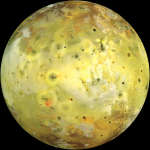
The strangest moon in the Solar System is bright yellow. This picture, an attempt to show how Io would appear in the "true colors" perceptible to the average human eye, was taken in 1999 July by the Galileo spacecraft that orbited Jupiter from 1995 to 2003.
 Grand Canyon Star Trails
3.03.2013
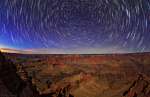
One of the natural wonders of planet Earth, the Grand Canyon in the American southwest stretches across this early evening skyscape. The digitally stacked sequence reveals the canyon's layers of sedimentary rock in bright moonlight.
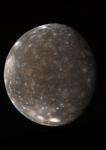 Oceans Under Jupiters Callisto
31.07.2001
Why does Jupiter's moon Callisto alter the magnetic field of Jupiter in its vicinity? Callisto itself does not have a strong magnetic field. One possible answer is that Callisto harbors sub-surface oceans of electrically conducting salt-water. This hypothesis was bolstered recently by a new analysis of how Callisto creates and dissipates heat.
|
January February March April May June July August September |
|||||||||||||||||||||||||||||||||||||||||||||||||