
|
You entered: supernova remnant
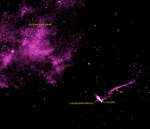 The Long Jet of the Lighthouse Nebula
21.02.2014
The Lighthouse nebula was formed by the wind of a pulsar, a rapidly rotating, magnetized neutron star, as it speeds through the interstellar medium at over 1,000 kilometers per second. Some...
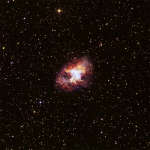 Cosmic Crab Nebula
25.07.2014
The Crab Pulsar, a city-sized, magnetized neutron star spinning 30 times a second, lies at the center of this tantalizing wide-field image of the Crab Nebula. A spectacular picture of one of our Milky Way's supernova remnants, it combines optical survey data with X-ray data from the orbiting Chandra Observatory.
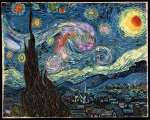 Starry Night Scavenger Hunt
15.06.2010
Did you know that Van Gogh's painting Starry Night includes Comet Hale-Bopp? Hopefully not, because it doesn't. But the above image does. Although today's featured picture may appear at first glance...
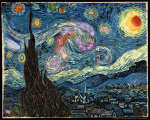 Starry Night Scavenger Hunt
18.09.2016
Did you know that van Gogh's painting Starry Night includes Comet Hale-Bopp? Hopefully not, because it doesn't. But the featured image does. Although today's picture may appear at first glance...
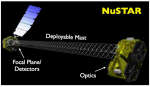 NuSTAR XRay Telescope Launched
19.06.2012
What's left after a star explodes? To help find out, NASA launched the Nuclear Spectroscopic Telescope Array (NuSTAR) satellite into Earth orbit last week. NuSTAR's ability to focus hard X-rays emitted from...
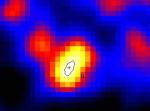 The Case of the Missing Supernova
13.04.1999
Would you notice a second Moon in the sky? About 700 years ago, light from a tremendous explosion reached Earth that should have appeared almost as bright as a full Moon. The bright spot should have lasted for weeks, yet no notation of such an occurrence has been found in historical records.
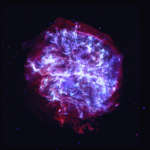 Elements in the Aftermath
1.08.2019
Massive stars spend their brief lives furiously burning nuclear fuel. Through fusion at extreme temperatures and densities surrounding the stellar core, nuclei of light elements ike Hydrogen and Helium are combined to heavier elements like Carbon, Oxygen, etc. in a progression which ends with Iron.
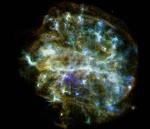 Elements in the Aftermath
26.10.2001
Massive stars spend their brief lives furiously burning nuclear fuel. Through fusion at extreme temperatures and densities surrounding the stellar core, nuclei of light elements like Hydrogen and Helium are combined to heavier elements like Carbon, Oxygen, etc. in a progression which ends with Iron.
 N132D and the Color of X Rays
23.05.2002
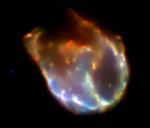
Supernova remnant N132D shows off complex structures in this sharp, color x-ray image. Still, overall this cosmic debris from a massive star's explosive death has a strikingly simple horseshoe shape. While N132D lies 180,000 light-years distant in the Large Magellanic Cloud, the expanding remnant appears here about 80 light-years across.
 High Velocity Clouds and the Milky Way
14.12.1999
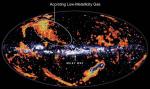
Where are these gas clouds going so quickly? High velocity clouds (HVCs) of gas have been seen for decades but their origins and destinations have remained mysterious. Recent measurements have now placed at least...
|
January February March April May June July August September October |
|||||||||||||||||||||||||||||||||||||||||||||||||